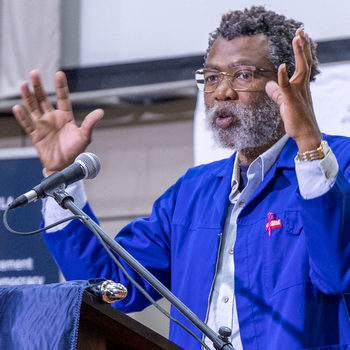
 Dr Lwazi Lushaba
Lushaba issued the challenge at Nelson Mandela University’s 16th Steve Biko Institutional Public Lecture in Gqeberha on 11 September, held on the eve of the 49th anniversary of the death of anti-apartheid activist and Black Consciousness leader Steve Biko.
The University of Cape Town academic argued that the problem lay in how South Africans understood colonialism – and therefore what it would take to undo its effects.
It was time, he said, “to return to retrieve from Biko his very insightful understanding of colonialism” and rescue a re-Africanisation debate that had “literally run to ground”.
Hosted by the University’s Centre for the Advancement of Non-Racialism and Democracy (CANRAD), the lecture took as its theme Re-Africanisation of Knowledge Systems and Governance for Liberation.
The programme was directed by Sphamandla Mhlongo and Katlego Mofokeng and included contributions from the Biko family, AZAPO and artists alongside the keynote lecture and response.
More than remembering Biko
Mandela University Deputy Vice-Chancellor for Engagement and Transformation Prof Andre Keet said the lecture – the University’s longest-running public lecture – was about far more than commemoration.
“We gather not simply to remember a remarkable figure, but to encounter an intellectual tradition that continues to place difficult and necessary questions before us,” he said.
The reopened inquest into Biko’s death brought those questions sharply into the present.
The inquest, formally reopened in September 2025, has been under way in the Gqeberha High Court. Just two days before the lecture, the court temporarily halted proceedings after the Biko family sought more time to prepare, including to obtain and translate material from Afrikaans into English.
At the lecture, AZAPO’s Nelvis Qekema said the organisation had attended the reopened inquest for three weeks. He said they had asked for proceedings to be paused because hundreds of pages of documents were in Afrikaans and needed to be translated.
Qekema linked the issue to Biko’s own stand against linguistic marginalisation, questioning why, under democracy, language had again become a barrier in proceedings dealing with Biko’s death.
Biko’s son, Nkosinathi Biko, who represented the family at the lecture, also spoke about the inquest and a visit he had made earlier that week to Room 619 of the former Sanlam Building in Gqeberha.
It was in Room 619 that Steve Biko was interrogated by apartheid security police in September 1977 and suffered the head injury that led to his death. Visiting the room almost 49 years later, his son said it had been altered to such an extent that another former detainee who had been tortured there could no longer recognise it. Biko told the audience that he had a list of about 120 people who, between 1963 and 1990, had been tortured, with accounts claiming that they had killed themselves.
‘Nothing untouched’
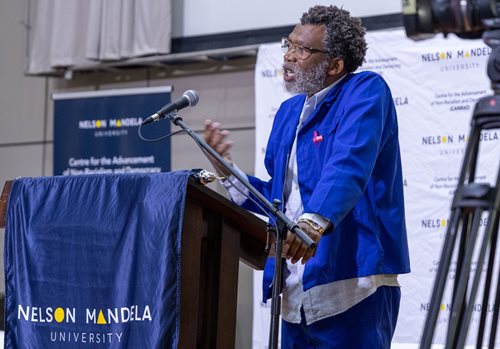
At the heart of Lushaba’s argument was Biko’s view that colonialism had to be understood as a whole system – not simply as one country taking political control of another.
“Colonialism does not leave anything untouched. It’s like a wall-to-wall carpet,” Lushaba said.
Its effects, he argued, spread through every part of life. Education, culture, institutions and the way people saw themselves were all changed.
That matters when South Africa talks about re-Africanisation.
If colonialism changed almost everything, Lushaba argued, its effects cannot be undone by changing one curriculum or institution at a time, or simply making more room for African voices in systems that remain largely the same.
He said two main approaches to re-Africanisation had failed to go far enough. One looked back to a pre-colonial African past, while the other sought greater African inclusion in existing institutions.
Both, he argued, missed the scale of what colonialism had changed.
Drawing on Nigerian scholar Peter Ekeh, Lushaba described colonialism as an “epoch rather than an episode”. Put simply, colonial rule may have had a formal beginning and end, but the deep changes it made to society did not disappear with it.
For Lushaba, this helps explain why Biko’s ideas still matter – and why, a decade after #FeesMustFall, he believes South Africa has made so little progress in re-Africanising its knowledge systems.
Knowledge beyond the university
Artist, poet, storyteller and Mandela University graduate Lelethu Mahambehlala, known as PoeticSoul, who has spent 13 years performing poetry at the lecture, took the discussion beyond universities and formal education.
She challenged artists, healers, storytellers and singers not to wait for an invitation to the “re-Africanisation table”, but to recognise themselves as part of creating it.
“Art is a knowledge system,” she said. “Let us redesign the African room together.”
Mahambehlala used the image of a table, with education as one leg and art, spirituality and community practice as the others.
Her message was that re-Africanisation could not happen through policy alone. These conversations also needed to happen in communities and everyday spaces – from streets and shacks to studios.
Thinking for ourselves
Lushaba pointed to Biko himself as an example of how African thought could develop without simply rejecting ideas from elsewhere.
Biko had read widely in the Western intellectual tradition, he said, but was not intimidated by it. Instead, he developed a philosophy rooted in South Africa and its own realities.
For Lushaba, that carried an important lesson: ideas that are distinctly African do not have to come only from a pre-colonial past, nor do they have to be built by rejecting Western thought.
Nearly 50 years after his death, Biko’s ideas continue to ask difficult questions of South Africa – not only about how the country remembers its past, but about how it chooses to shape its future.
A son remembers Biko
Nkosinathi Biko shared two childhood memories of his father – and reflected on what Steve Biko’s death continues to ask of South Africans.
Representing the Biko family at the lecture, Biko recalled walking home from crèche in Ginsberg in 1975 when he saw his father driving past the site where the Steve Biko Centre now stands.
“I ran over to flag him down and he wore a huge smile and asked me to go home and meet my new brother, Samora.”
He went home and found his baby brother – “this little fellow with lazy eyes and shrunken hands”.
“If ever my parents taught me how to receive love, he is the man who taught me how to express love. As a firstborn I learnt that the world is much bigger than I am.”
His second memory was from 1977, when he looked into his father’s coffin.
The eyes he saw, Biko said, were not those he remembered from sitting on his father’s lap and stroking his beard. It was evident from his appearance, Biko said, that his father had suffered trauma. He also reflected on what the experience meant for him as a child.
Biko then turned to what could still be learnt from his father’s death.
“If there is a wish, it is that from his death we can continue to extract very important lessons. And this is why gatherings of this kind are important – remedial and restorative.”
Such gatherings mattered to the family, he said, but also to the nation. His father was no longer here to care about how he was remembered; what mattered was what the living chose to do with that legacy.
“What we do about them is a reflection of our own soul.”