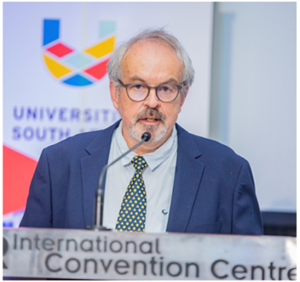
 Professor Jean Greyling
What began as an honours project at Nelson Mandela University has grown into an international educational movement, reaching more than 350 000 learners across nine African countries and countries including Ireland, South Korea, Cyprus, Germany and Indonesia.
Tangible Africa, an initiative that teaches coding without requiring computers, electricity or internet access, has earned several national and international accolades, including the 2024 Information Technology Professionals South Africa (IITPSA) President’s Award.
In 2025, Universities South Africa (USAf) selected it as one of the country’s leading societal impact cases.
For more than 25 years, Prof Greyling visited Eastern Cape schools, hoping to inspire learners to pursue computing. Often, however, he encountered children who had never seen a computer and schools without electricity.
That changed in 2017 when honours student Byron Batteson developed TANKS, a mobile application using physical coding tokens and smartphone image recognition. Prof Greyling describes it as the best honours project he has supervised in three decades. Batteson is now a senior software engineer at Amazon.
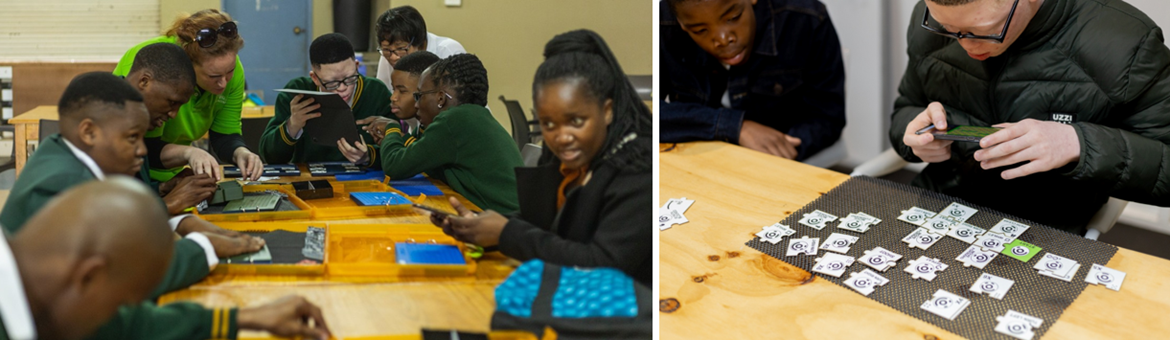 Tangible Africa uses small, puzzle-like tokens to represent coding instructions. Learners arrange the pieces to solve challenges, photograph their solutions using a phone and watch their programmes run.
Implemented through the Leva Foundation, the initiative addresses significant educational inequalities. With coding and robotics now part of South Africa’s curriculum from Grade R to Grade 9, Tangible Africa offers teachers practical tools to introduce computational thinking, even in under-resourced schools.
Teachers can be trained in just three hours, while lessons aligned with the national CAPS curriculum are available through a chatbot. The project also supports learners with visual impairments through Braille and 3D-printed resources. Approximately 90% of participating schools pay nothing, reflecting its commitment to accessible education.
Learning is deliberately fun and collaborative. Inter-school tournaments have transformed coding into a spectator sport.
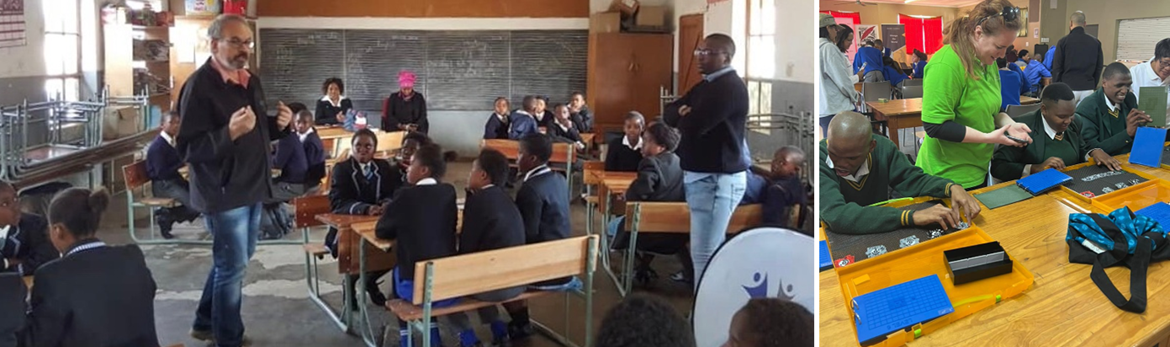 The annual Mandela Month tournament attracted 50 000 learners from 500 schools in 2025, generating 220 000 engagements with the project’s products in one month. Its global coding World Cup brought together 340 teams from 30 countries across five continents.
Beyond coding, the initiative develops problem-solving skills through decomposition, abstraction, pattern recognition and algorithms. Coding clubs also introduce Grade 9 learners to design thinking, entrepreneurship and STEM careers, helping them understand the importance of mathematics.
For University of Pretoria student Katlego Nyambi, a school workshop proved life changing. Initially uncertain about his future, he discovered programming and improved his academic average by 20% within six months. He is now studying computer science on an Amazon bursary.
Having undergone two global evaluations, including UNICEF’s Learning Cabinet, Tangible Africa demonstrates how locally developed university innovation can achieve international impact.
Prof Greyling emphasised that sharing these achievements is equally important. Through social media and dedicated communication efforts, the team ensures its research reaches audiences beyond academia.
Tangible Africa’s success illustrates how accessible, playful learning can bridge the digital divide, empower teachers and help young people discover opportunities they might never otherwise have imagined.
Source: From one university honours project to five continents: Tangible Africa’s unplugged coding revolution by Janine Greenleaf Walker, Universities South Africa