Dating back to the pre-merger period, the partnership has evolved across generations, with some healers now collaborating with University staff who first engaged with them as students.
This enduring relationship reflects the partnership’s contribution to the University’s intellectual project.
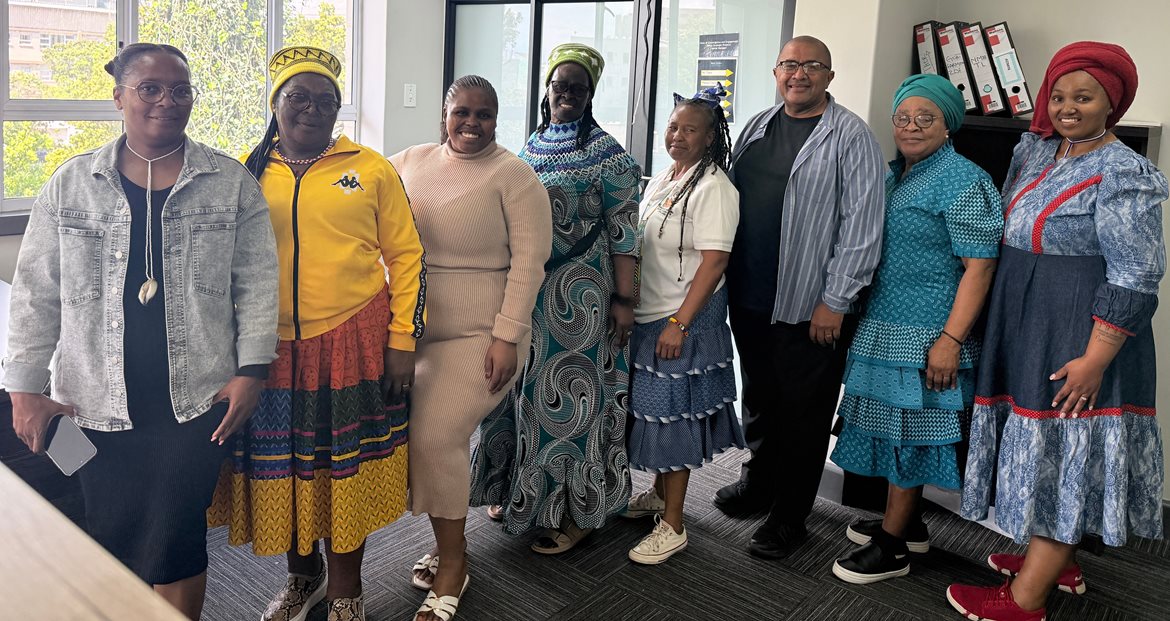
The Nyangayezizwe Traditional Healers together with the Engagement Office's Dr Bruce Damons and Phaello Thlaku
A key focus of the discussion was the need for a structured agreement outlining the short- and long-term reciprocal benefits of the partnership. The healers also raised concerns about the recognition of their intellectual and programmatic contributions to various University collaborations.
The Engagement Office acknowledged the need for deeper institutional reflection on how different knowledge traditions are valued and how knowledge holders involved in co-creating knowledge are appropriately recognised and compensated.
The Engagement Office acknowledged that these conversations invite deeper institutional reflection on how different knowledge traditions are valued and how those involved in the co-construction of knowledge are appropriately recognised and compensated.
These conversations provide an opportunity for the University to strengthen its commitment to knowledge democracy, reciprocity and humanising engagement.
The meeting resulted in three commitments: The Engagement Office will convene a strategic planning session with Nyangayezizwe in early 2027 to develop a formal agreement and shared roadmap that incorporates existing University collaborations. The healers are also encouraged to negotiate appropriate recognition and compensation with the University cohorts with whom they collaborate. Lastly, the Engagement Office will remain available to support these engagements where needed.
The healers welcomed the opportunity to raise concerns and explore possibilities for collaboration in a constructive institutional space. Both parties recognised the value of these conversations as opportunities for mutual learning and for strengthening this historic partnership.
Beyond the immediate commitments, the engagement raises a critical question for the University: How do we move beyond inviting different knowledge traditions into our institutional spaces towards recognising their knowledge holders as equal partners in the co-construction of the University's intellectual project?