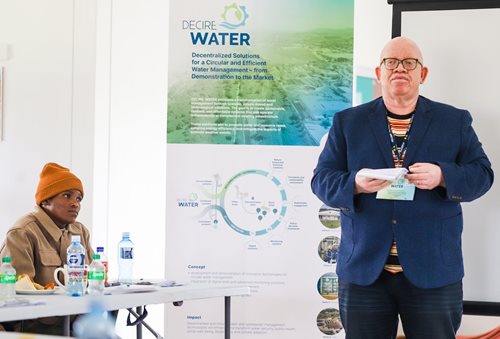
Professor Sijekula Mbanga
Prof Mbanga is the Chair of Human Settlements in the Department of Building and Human Settlement Development (a national academic and technical portfolio) at Nelson Mandela University.
Here Prof Mbanga discusses South Africa’s housing crisis, the role of innovative building systems, and the urgent need to move beyond housing delivery towards creating inclusive, sustainable and climate-resilient human settlements.
PG: What is the mandate of the Chair and the urban development challenges it seeks to address?
SJ: The Chair of Human Settlements was established in 2013 with funding from the National Department of Human Settlements. Its mandate is to support the development of formal and non-formal training programmes, lead the professionalisation of South Africa’s human settlements sector and conduct research that addresses the daunting housing and human settlement challenges in South African cities, towns and villages.
From 2020, the Department of Science Technology and Innovation funds the Chair through specific research projects with broader societal impact.
Key urban development challenges being addressed include housing shortages and the effectiveness of housing delivery policies and systems; limited integration of land, housing and urban infrastructure that lead to unsustainable settlements; a dire housing and human settlement development skills and ethics deficit; and the lacking resilience in the planning and implementation of human settlement developments.
It also provides input into the introduction of human settlement academic programmes and engages on research that would influence a shift in national policy from the provision of housing to the development of sustainable human settlements and cities.
The South African government had realised that the provision of mass housing continued to deepen the apartheid spatial geography, creating different class and income enclaves in South African cities. The housing programmes implemented across municipalities did not consider the evolving global mega trends, such as climate change, rapid urbanisation, resource depletion and the declining fiscus due to ailing economies.
PG: South Africa continues to face a severe shortage of adequate, affordable housing, alongside growing informal settlements and spatial inequality. What do you consider the most urgent challenges that need to be addressed?
SJ: South Africa’s housing crisis is not a mere challenge of demand-supply mismatch, but structural and systemic. It has its roots in the structure and functionality of the economy where most citizens, including the post-1994 'born free,' appear on indigent registers of local authorities.
Deepening income inequality, high rate of unemployment (including graduate unemployability), and constantly declining and unstable sectors of the economy suggest that citizens rely on state grants to meet their basic needs.
Informal settlements are a physical expression of urban poverty, as people migrate from declining rural and cross-border economies to cities in search of livelihoods and access to basic services.
Access to developable land in areas that promote socio-economic integration and in proximity of social and economic opportunities, would allow people to build homes and engage in economic activities.
PG: The theme of this year’s commemoration is “Adequate housing for all through mainstreaming of innovative building systems”. What do you mean by innovative building systems, and how could they help South Africa respond to its housing crisis?
SJ: Innovative Building Systems (IBSs), also referred to as Innovative Building Technologies (IBTs), represent construction materials and methods that reduce construction costs and time, thereby promising a timeous delivery, at scale, of quality, energy efficient houses.
These innovative systems include walling, insulation and roofing materials that depend on their cost, availability and skills. The introduction of new materials, construction methods and set of skills increases the delivery scales. This is different from self-help housing where people make use of any available materials, including mud in rural areas.
Innovative Building Systems undergo robust engineering tests for structural soundness and performance under different climatic conditions. IBSs that optimise on local materials reduce the cost of the house, as well as provides economic off-spins by catalysing the local manufacturing sector.
PG: Can innovative construction methods reduce the cost and time required to build homes without compromising their quality, safety and durability?
SJ: Compliance by innovative construction methods and systems with national building regulations, and the certification of non-standardised construction materials by regulatory bodies, such as Agreement South Africa, remains.
Non-conventional construction materials, products and systems undergo a rigorous test for structural integrity and performance against environmental shocks, with system owners being certified by Agreement South Africa.
The home building industry (subsidy and non-subsidy sectors) are regulated in South Africa with the National Home Builders Registration Council mandated by the Housing Consumers Protection Measures Act, 1998, to register homebuilders, and enrol and inspect housing projects to protect housing consumers from sub-standard construction practices.
PG: Please provide us with examples of research, technologies or practical interventions emerging from the Chair that have the potential to improve housing and living conditions?
SJ: Research is underway in Kenton-on-Sea, Ekuphumleni Township in Ndlambe Municipality in the Eastern Cape, a transdisciplinary, multi-sector and international cooperation initiative on technology transfer in low-income communities within rapidly urbanising societies.
Ndlambe EcoSUN Green Village is a site where research method, policy and practice meet - North-South and South-North knowledge and academic exchanges are in practice and for community benefit. This research occurs in a planned informal settlement upgrading programme of the Eastern Cape Department of Human Settlements and Ndlambe Municipality (centred in Port Alfred).
Here countries in the south are incorporating innovations and technologies within a housing project that was designed along traditional approaches of housing, water, energy, food security and waste management provision.
A comparative life-cycle cost assessment of selected building systems is being undertaken to determine their building and operational costs and provide advice to policymakers and housing consumers regarding their housing choices.
A conditional assessment of a selected eight informal settlements within the Nelson Mandela Bay Municipality was implemented to inform the municipality planning and reblocking strategies (rearranging and repositioning existing structures). These informal settlements include the Vistarus-Rolihlahla Informal Settlement, which has been preplanned for de-densification.
PG: How does the Chair work with communities to understand their housing needs and ensure that proposed solutions respond to their lived experiences?
SJ: The Chair adopts participatory methods in its research interventions. For example, in the Ekuphumleni Township in Ndlambe Municipality, the ward councillor, community development worker and the Green Village Project Committee participate in meetings and community workshops.
The Chair meets with local enterprises and non-government organisations, where it conducts research. Some seek long-term partnerships with the University, such as the Federation for the Urban Poor.
Also, the Institute of Human Settlement Practitioners South Africa, an association that leads the professionalisation of the human settlements sector in South Africa, was launched by the Minister of Human Settlements at the University.
PG: Can you point to a project or intervention where the Chair’s work has already made a measurable difference, or where there is clear evidence of its potential impact?
SJ: The Institute of Human Settlement Practitioners South Africa has been established, as well as a student and graduate placement programme, also being concluded between the Institute and the National Department of Human Settlements.
The Chair coordinated inputs of academics in South Africa in the review of the National Housing White Paper, which brought about a reform in policy and practice from the delivery of housing to development of sustainable human settlements.
It also influences the content of human settlements curricula at South African universities, which offer housing and human settlement academic programmes. Furthermore, it utilises its involvement in the Institute of Human Settlement Practitioners South Africa, which represents academic, practitioners, student chapters and business connections.
The Chair also contributes to the review of national housing policies and provincial strategies and legislation that supports the country’s transition from housing delivery to the creation of sustainable human settlements.
PG: How can innovative building systems contribute to more climate-resilient housing and settlements?
SJ: In their climate adaptation strategies cities should identify, adopt and employ climate disaster risk mitigation strategies. Climate resilient thinking should inform sustainable urban development and built environment practice.
Innovative Building Systems provide an opportunity for cities to build better and smart and be proactive in responding to climate disasters. These systems are designed to respond to different climatic conditions and energy zones.
Climate resilient settlements also include a need to mainstream innovative building systems and technologies in water provision, energy supply, waste disposal, wastewater management and sanitation solutions for water scarce regions.
PG: What is Nelson Mandela University's distinctive contribution to the national and international conversation on sustainable cities and how does its work connect with broader global urban development agendas?
SJ: Research councils, other universities and urban research networks tap into the expertise of the Chair, which has been approached to provide advisory services to the newly opened United Nations Habitat South Africa Country Office, which aims to service the South African Development Community region.
The Chair focuses on people, planet and prosperity, and takes an academic approach that views a city as a system of im(possibilities).
Housing needs are seen as elusive in the entire residential property market, and homelessness in its totality, whether it is expressed through physical informal settlements, hijacked inner-city buildings, or hidden vulnerabilities in derelict boats, as well as dilapidated mud houses in rural areas, street dwellings or decaying downtown neighbourhoods across the globe.