The three-part launch, hosted by the University’s Faculty of Humanities in August, followed a lecture and related activities exploring the linguistic history, development and future of Kaaps.
At the heart of the project is a collective body of community engagement and historical research aimed at documenting and formalising Kaaps while recognising the rich linguistic influences that have shaped it over centuries.
Prof Quentin Williams, who heads the project and is president of the Societie virrie Advancement van Kaaps (SAK), presented research tracing the origins and development of Kaaps across centuries of archival sources.
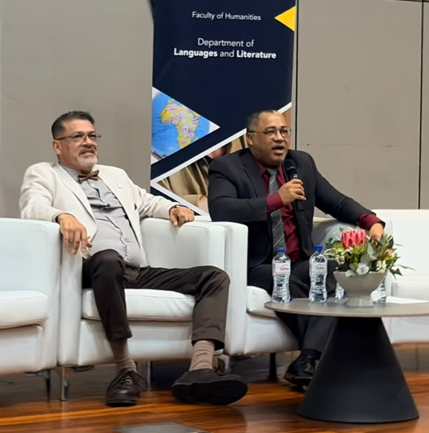 Dr Theodore Rodrigues and Professor Quentin Williams
This includes evidence of early contact between Dutch and Khoe communities from the late 1500s, when Dutch words were used by Khoekhoe speakers for purposes of trade.
The subsequent development of Kaaps was shaped by contact between Dutch, Khoe languages and the languages of enslaved people at the Cape, including creole Portuguese, Malay dialects, Javanese, Acehnese and Arabic.
According to the research presented as part of the project, Kaaps has developed through contact with around 117 other donor languages, including Hokkien Chinese.
The historical record also provides an important perspective on the name itself. The first written evidence of “Kaaps”, then recorded as “Caaps”, dates to 1775, according to the research presented at the launch.
This history underpins a central proposition of the project: “Kaaps is a language, not a variety of Afrikaans.”
The launch provided an opportunity to explore what that proposition means in practice, particularly in relation to the formalisation of Kaaps and its place in education, scholarship and society.
The Deputy Dean of the Faculty of Humanities, Dr Jacqui Lück, highlighted the broader relationship between language and knowledge during her opening remarks, noting that all languages possess power for the representation of knowledge, but that some languages have historically been excluded from the canon and denied intellectual authority because they are not regarded as “language” or do not conform to a particular standard.
The project distinguishes between formalisation and standardisation. Rather than imposing a prescriptive standard on Kaaps, formalisation seeks to document and validate the way in which the language is used while allowing for its inherent variability.
This was demonstrated during the “How to Write in Kaaps” workshop, where Prof Williams and Dr Theodore Rodrigues explored aspects of the language’s orthography and development.
Agglutinative language examples such as “issie” and “gi’horittie” illustrate the way in which written Kaaps seeks to capture the language as it is spoken, while the workshop also explored how meanings can change through processes of translation and linguistic contact.
The launch also brought the language into conversation with its everyday use.
Around 100 pupils from Gamble Street High in Kariega and Chatty High in Gelvandale attended the official launch at Nelson Mandela University, where Williams and Rodrigues connected the historical development of Kaaps with familiar words and expressions such as “awê” or “aweh”, a greeting, and “bômpie”, referring to an ice lolly sold in a small plastic bag.
For the project’s proponents, this connection between formal linguistic work and everyday experience is important.
The formalisation of Kaaps has also been framed as a matter of social justice, particularly because many Kaaps speakers are working class and the language has historically occupied limited space in formal educational and intellectual settings.
Williams told the audience that Kaaps speakers cannot “eat their language”, while emphasising the potential for formalisation to create opportunities for the language to be taken up in educational spaces in the future.
The launch further opened discussion about the relationship between Kaaps and Afrikaans, including questions about whether Kaaps should be regarded as a variety of standard Afrikaans, whether it could be incorporated into standard Afrikaans, and how other varieties of Afrikaans and the role of English in Kaaps should be understood.
Williams and Rodrigues reiterated the project's position that Kaaps should be understood as a language in its own right, rather than as a variety of Afrikaans.
The programme also highlighted the cultural life of Kaaps, with local poets Leonie Williams, Luciano Roberts and Bevan Boggenpoel, together with rap artist Sasso Vlet, sharing their work in Kaaps.
The discussions ultimately turned towards the Eastern Cape and what the formalisation of Kaaps could mean for the province.
Two students, Nthabiseng Nteta and Bulelwa Ngxolo, who study Afrikaans and are multilingual isiXhosa/Afrikaans home-language speakers, reflected on the interconnected nature of their linguistic identities.
Their reflections contributed to a broader conversation about the future of Afrikaans and the importance of engaging with the language’s contested history.
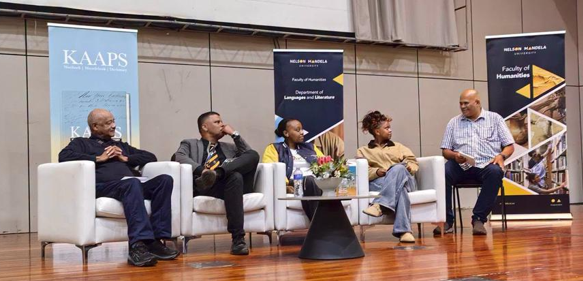 Vincent Oliphant, Johan Wicomb, Nthabiseng Nteta, Nuwelwa Ngxolo and Selwyn Milborrow
This conversation has also given rise to a tentative proposed project, OosKaaps, involving Faculty of Humanities academics Chanel van der Merwe, Dr Jacqui Lück and Selwyn Milborrow.
The proposed project seeks to explore the linguistic realities of the Eastern Cape through engagement with communities, archives, existing research, music, drama and other forms of cultural expression.
For Dr Lück, this work should be co-created with communities in the province, creating space for Eastern Cape speakers to participate in documenting and understanding their own linguistic heritage.
The Kaaps Woriboek launch extended beyond the publication of a linguistic resource, opening a wider conversation about language, history, identity, knowledge and the power of communities to name and develop their own linguistic worlds.