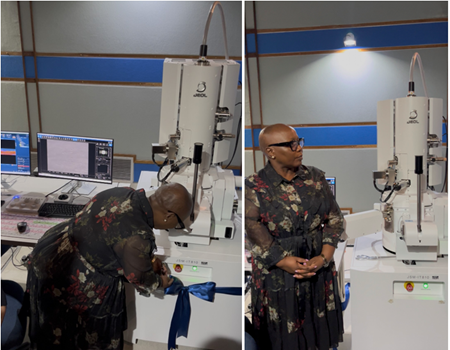
 Deputy Minister of Science, Technology and Innovation, Dr Nomalungelo Gina
The Deputy Minister unveiled two new scanning electron microscopes (SEMs) that offer greater stability, faster acquisition, substantially stronger signals, and sharper images than the predecessor equipment at the University’s Centre for High Resolution Transmission Electron Microscopy (CHRTEM).
Dr Gina joined the Centre based at Mandela University’s South Campus yesterday as part of its 15th anniversary celebration.
The CHRTEM was established in 2011, with R90-million funding from the Department of Science, Technology and Innovation (DSTI) and its entity, the National Research Foundation (NRF). The Department of Higher Education and Training (DHET) provided R30-million towards the Centre’s building.
Dr Gina remarked that the unveiling underscored the continued evolution and renewal of national research infrastructure, directly aligned with the NRF and DSTI’s strategic priorities.
“The 15th year is not simply a moment to celebrate what has been built, but to commit to ensuring that South Africa remains equipped to see, measure, understand and engineer matter at the scales at which the technologies of tomorrow are being developed,” said the Deputy Minister.
She added that the milestone highlighted how national research infrastructure must continuously evolve to remain relevant, and how strategic public investment enables South Africa to remain competitive in advanced characterisation as technologies demand ever-greater precision at ever-smaller scales.
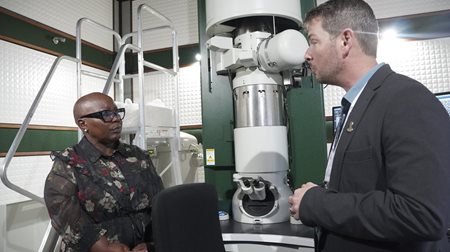
Professor Jaco Olivier, Director of CHRTEM, showcasing the microscope to the Deputy Minister
Professor Jaco Olivier, Director of CHRTEM, took the Deputy Minister through the centre, detailing its history and key milestones. Prof Olivier explained that the centre uses SEMs extensively to study structural materials, particularly steel and aluminium alloys.
He said the two new SEMs represent a strategic phase of infrastructure renewal as CHRTEM’s original instruments approach the end of their factory support.
“The acquisition substantially expands Mandela University’s capabilities in advanced scanning electron microscopy and interdisciplinary bioimaging,” he said, adding that the new equipment replaced ageing instruments with advanced technology to maintain South Africa’s competitiveness.
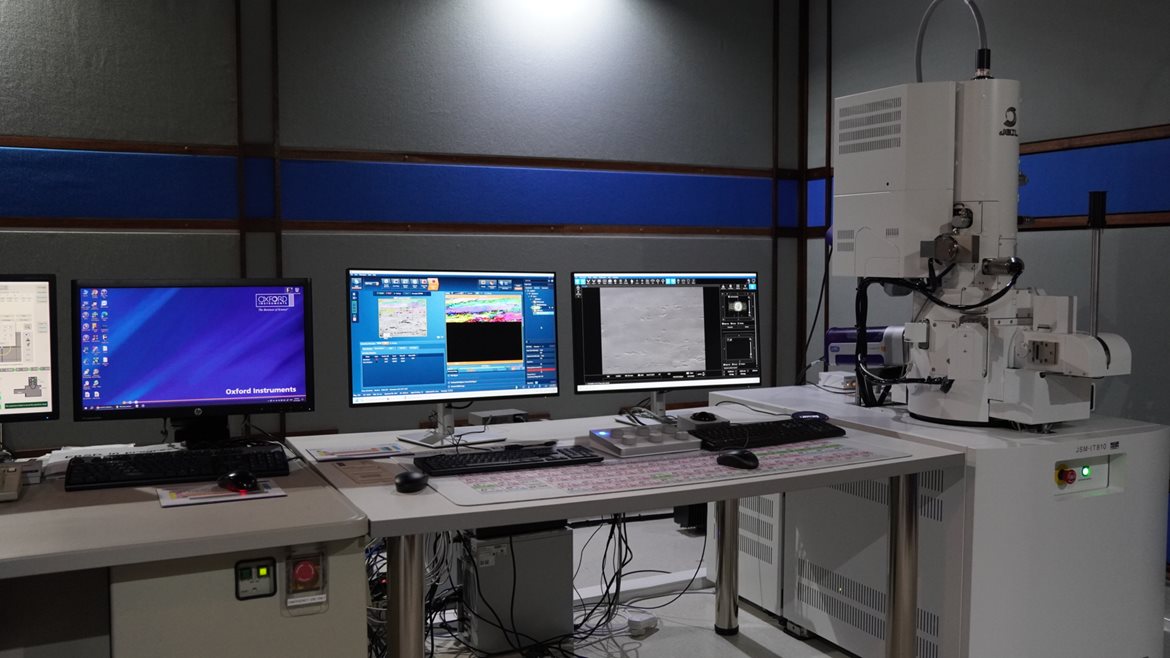
The new scanning electron microscope (SME)
The other significance is the expansion of the Centre’s capabilities beyond traditional materials sciences into biomedical imaging and the bioeconomy. It also positions CHRTEM for the next 15 years of technological challenges and sustains the commitment of the DSTI, the NRF and the University to national research infrastructure.
Speaking at a gala dinner celebration later in the day, Dr Gina paid tribute to the partnership, including industry partners such as Sasol, Element Six, and Pebble Bed Modular Reactor, for co-investing with government over the years, saying CHRTEM has held a unique and profound distinction.
“It remains the only facility on the African continent that is home to a double aberration-corrected transmission electron microscope. It is the only place in Africa where scientists can physically see and manipulate atoms,” said Dr Gina.
During the period, the facility logged over 40 000 microscope hours, 1000 students supported and trained, conducted more than 700 research projects, serving as a critical engine for South Africa’s system of innovation.
From investigating the structural integrity of materials used in heavy industry to unlocking innovations in energy storage, advanced manufacturing and health sciences, CHRTEM has proved that small-scale observations yield continent-wide impact.
The Deputy Minister said science in Africa was growing persistently, welcoming the news that Morocco was currently installing its own advanced aberration-corrected microscopy infrastructure.
“We celebrate this expansion of advanced scientific infrastructure across the Global South. It validates the path we chose 15 years ago and opens new doors for African leadership and collaboration in the global scientific arena,” said Dr Gina.
The Deputy Minister said the country’s science policy implementation plan required South Africa to prepare for a digital, tech-driven future, which the Centre had transitioned from simply asking where the atoms are, to answering how the atoms behave.
With the CHRTEM having supported and trained a significant number of students over the years, it has opened doors to postgraduate researchers from diverse institutional backgrounds across the country and internationally.
To maintain global competitiveness, Dr Gina urged the CHRTEM to look beyond the horizon, saying the DSTI remained fully committed to supporting strategic research infrastructure through frameworks such as the South African Research Infrastructure Roadmap.