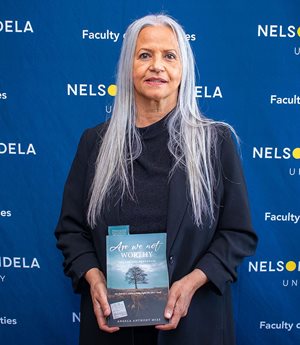
Angela Mias
The work chronicles her family’s century-long struggle to reclaim their ancestral land and raises broader questions about justice, belonging and democratic trust.
Drawing on years of archival research, Mias traces her family’s history of land dispossession and its protracted journey through South Africa’s land restitution process.
What began in 1994 as a search for her family’s history developed into an investigation of the historical records, institutional delays and personal consequences surrounding their claim, submitted in 1996.
“I was looking for the place of my family in the history of this country,” Mias told the audience at the launch, held in the Council Chambers on the University’s South Campus.
Her account highlights how land represents more than property or economic value. It is also tied to ancestry, identity, heritage and the connection between generations. Mias reflected on how decades of waiting have affected her family, with uncertainty and disagreements deepening existing divisions.
The experience has also prompted her to question what restitution is intended to restore, and whether justice is achieved when families wait decades for their claims to be resolved.
“Is it still justice when those seeking it have already waited a lifetime?” she asked.
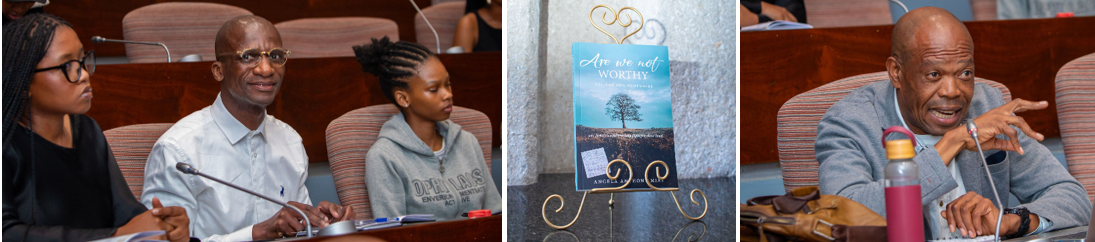
From left, Nompumelelo Fukuthwa, programme director and history master’s student and Professor Ntsikelelo Breakfast, Head of the History & Political Studies Department. Right, Dr Vusi Kumalo , senior lecturer in the History & Political Studies Department
Opening the event, Professor Ntsikelelo Breakfast, head of the Department of History and Political Studies, situated the book within South Africa’s unresolved land question, describing land as central to the country’s economy, political identity and relationship between the powerful and the powerless.
He noted that the book’s family-centred account offers lessons for nation-building and social cohesion.
History master’s student and programme director Nompumelelo Fukuthwa highlighted the importance of looking beyond legislation and official records to understand how historical injustices continue to shape people’s lived experiences.
The audience discussion further underscored the ongoing human cost of unresolved land claims.
Historian Dr Vusi Kumalo shared his experience of researching a family’s claim whose original participants had since died, raising questions about the burden placed on younger generations to continue the pursuit of justice.
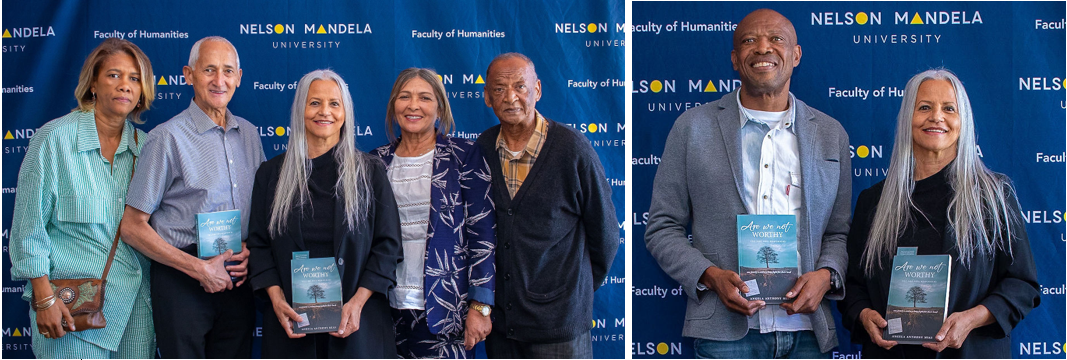
From left, Angela Mias with her former schoolteachers and with Dr Kumalo
South Africa’s celebrated education leader, Professor Jonathan Jansen, captured the wider significance of Mias’s account, writing: “Yours is a story that speaks for so many without the voice or resources to bring their pain to the surface for public consciousness.”
Although rooted in one family’s experience, Mias hopes the book will contribute to a broader conversation about land restitution, historical memory, citizenship and the relationship between ordinary people and democratic institutions.

Ultimately, Are We Not Worthy – Yet the Soil Remembers offers a deeply personal account of the enduring consequences of land dispossession, reminding readers that restitution is not only about reclaiming land, but also about recovering family histories, restoring dignity and rebuilding a sense of belonging.