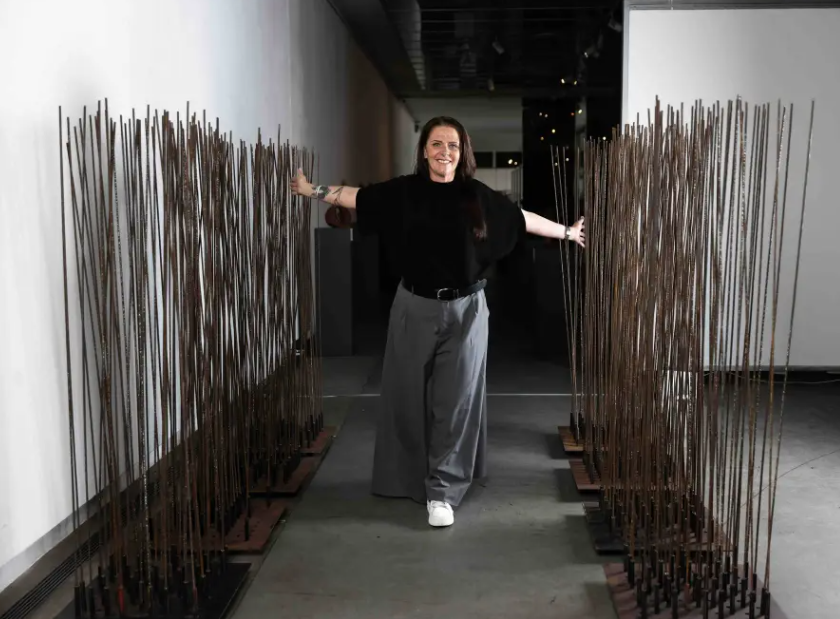
 Charné’s Echoes of Silence installation, consisting of steel rods, is also included in the exhibition at the Pretoria Art Museum until 8 November 2026.
This is her second year entering the competition. In 2025, her work 5 271 Days Behind Trauma was selected as a finalist in the regional round.
That recognition strengthened her confidence in her practice and encouraged her to push her concepts further. Echoes of Silence grew from that continued development.
 Working mainly in sculpture and mixed media, she combines printmaking, sculpture and unconventional materials to challenge traditional ideas of materiality.
As a mature student, Charné brings experience in the corporate sector, particularly in design, photography and marketing, and started her studies at the age of 45.
She then discovered sculpture and found a sense of belonging in its physical, three-dimensional nature.
Charné is comfortable working with natural materials, such as wood and clay but has increasingly been drawn to steel and other metals. She deliberately chooses materials that challenge her physically or technically, seeing the process of making as an integral part of the work itself.
She is particularly interested in gender-based violence in South Africa and the systems that continue to fail victims, women and children. Her work questions the attitudes and structures that contribute to vulnerability, silence and the absence of justice.
Echoes of Silence responds to the Human Sciences Research Council's 2024 statistics on gender-based violence in South Africa. The scale of reported sexual violence left Charné with an overwhelming sense of heaviness and compelled her to respond through sculpture.
Rather than speaking for victims, the work seeks to create space for dialogue around an issue that is often difficult and uncomfortable to confront. It also challenges the tendency to place blame or responsibility on victims. Through the work, Charné wants survivors to know that they are seen and heard.
The installation consists of steel rods marked to represent each reported case of sexual violence reflected in the statistics: 2,150,342 marks in total. Charné initially intended to make every mark individually using a Dremel tool. On her first day, she produced 3,160 marks in six hours. At that rate, completing the work would have taken approximately 680 days.
Although she was advised that the concept was strong enough without physically making every mark, she felt that each reported case needed to be individually acknowledged. Through experimentation and problem-solving, she developed a process that eventually allowed her to produce up to 70,000 marks in a single day.
The completed installation weighs approximately 270 kilograms. Moving and managing the work in sections created its own physical challenges, but Charné came to see this strain as part of the process, a small physical sacrifice reflecting, in some way, the emotional weight carried by victims of gender-based violence.
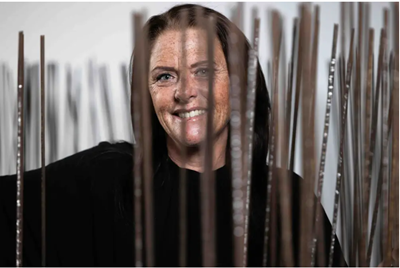 Steel became an important material choice because of its strength, rigidity and unforgiving nature. Looking through the steel rods, the viewer encounters both absence and presence: the silence surrounding these experiences and the countless lives represented within the structure.
As a wife, mother, daughter and woman, Charné feels a personal responsibility to challenge the normalisation of gender-based violence and contribute to meaningful change through her art.
After completing her Honours degree, she intends to develop new collections, explore collaborations and group exhibitions, and continue experimenting with concepts and materials.
Her future work will continue to engage with the experiences of South African women while exploring both the harsh realities reflected in statistics and the humanity behind them. She envisions using metal to confront difficult realities and statistics, while using wood to celebrate women, their strength, resilience, roles and value.
For Charné, these materials hold different kinds of stories. Steel can embody weight, resistance and the harshness of reality, while wood can suggest warmth, growth, resilience and the human being behind the statistic.
Echoes of Silence has given her an opportunity to begin a national conversation. Her intention is to continue that conversation through her evolving practice and to use sculpture as a means of questioning, remembering and advocating for change.