The transition will be driven by a new 10-year renewable electricity agreement with Etana Energy, together with the rollout of the University’s new 4.4 megawatt (MW) solar photovoltaic (PV) platform across its campuses. Etana is a licensed electricity trader that supplies renewable electricity through the national grid.
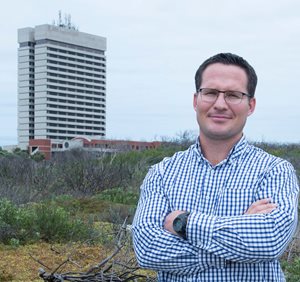 Dr Andre Hefer
“Between 50% and 55% of the University’s electricity will be purchased from Etana,” said Sustainability Engineer Dr Andre Hefer of the University’s Infrastructure Services and Space Optimisation (ISSO) Directorate.
“In addition, our new solar PV platform is expected to provide a further 25% to 30% of campus-wide electricity requirements, taking our renewable energy supply to about 80%. The remaining electricity will be sourced from Eskom and the University is also strengthening our generator infrastructure to provide centralised backup power during outages.
The renewable-energy programme will significantly enhance the University’s energy security and cost savings, while reducing its carbon footprint. Hefer said at a target of 70% to 80% renewable electricity, the University could reduce its carbon emissions by approximately 12 000 tonnes a year, based on its current annual electricity consumption.
Etana CEO Evan Rice said the agreement demonstrated the growing role of large public-interest institutions in South Africa’s energy transition.
“Large electricity users have typically meant mines and heavy industry, but this agreement shows that large public-interest institutions like universities can play just as critical a role in underpinning investment in new clean energy generation capacity,” he said.
“By committing to long-term offtake, Nelson Mandela University is helping to bring new renewable projects onto the grid, while securing cost certainty and reducing its carbon footprint.”
The University’s efforts form part of a broader national shift towards a more secure, affordable and sustainable energy future. South Africa’s Integrated Resource Plan 2025 places increased renewable-energy generation at the centre of efforts to strengthen electricity security and reduce the environmental impact of power generation, while the South African Renewable Energy Masterplan seeks to grow the renewable-energy sector and support a low-carbon economy.
This investment by the University demonstrates how public institutions can play a practical role in this transition while developing more sustainable models of energy supply.
 Melvin Syce
ISSO Senior Director Melvin Syce said the experience of 2023 made finding a more sustainable and reliable energy model an urgent priority.
“The decision to significantly boost our renewable electricity generation capacity came on the back of the major load-shedding we experienced, which peaked in 2023 when the University was without Eskom-supplied electricity for what amounted to a third of the year. We had to resolve the issue as a matter of urgency, for both operational and financial reasons. During the outages, for example, we were using 6 000 litres of diesel per day in our generators at a cost of about R150 000 per day, which was not sustainable.”
The University spends about R60-million a year on electricity. Under the Etana agreement, it expects to save between R2-million and R2.5-million annually, with the annual price adjustment linked to the Consumer Price Index, currently averaging about 4.3%, rather than the projected higher Eskom increases.
The new 4.4 MW solar PV platform is expected to generate an additional annual saving of between R8-million and R10-million. Together, the two interventions have the potential to substantially reduce the University’s annual electricity costs while providing greater certainty over future energy expenditure.
The solar PV platform comprises more than 8 500 panels and is being rolled out across all seven campuses in the Eastern and Southern Cape. It builds on the University’s experience with renewable energy, following the installation of its first 1 MW solar PV plant at the Summerstrand South Campus, which has been generating electricity since June 2019.
From May 2027, Etana will wheel renewable electricity to participating users in the Nelson Mandela Bay Metro through the Eskom grid serving the Metro. Etana has already secured the necessary grid capacity.
Mandela University is part of a broader initiative by major electricity users in the Metro to develop collective solutions to the region’s energy challenges. Dr Hefer represents the University on the Nelson Mandela Bay Business Chamber’s electricity task team, which brings together about 30 of the Metro’s largest electricity users to explore a collective approach to renewable-energy procurement and energy security. Etana was selected through a competitive process undertaken on behalf of participating large energy users.
“Our investment in renewable energy takes the University forward in a very positive, more sustainable and financially responsible way of powering our campuses,” said Syce. We hope our experience can inspire similar models and interventions at other universities.”