The inaugural Digital Humanities (DH) Cluster Summit, hosted at the University of South Africa (UNISA), brought together representatives from at least 20 institutions to define the field, strengthen collaboration and establish shared priorities for its advancement in higher education and research.
Convened jointly by Mandela University, through its Digital Humanities Hub, North-West University, UNISA and the South African Centre for Digital Language Resources (SADiLaR), the summit is expected to lay the groundwork for a South African Digital Humanities position paper, scheduled for completion later this year.
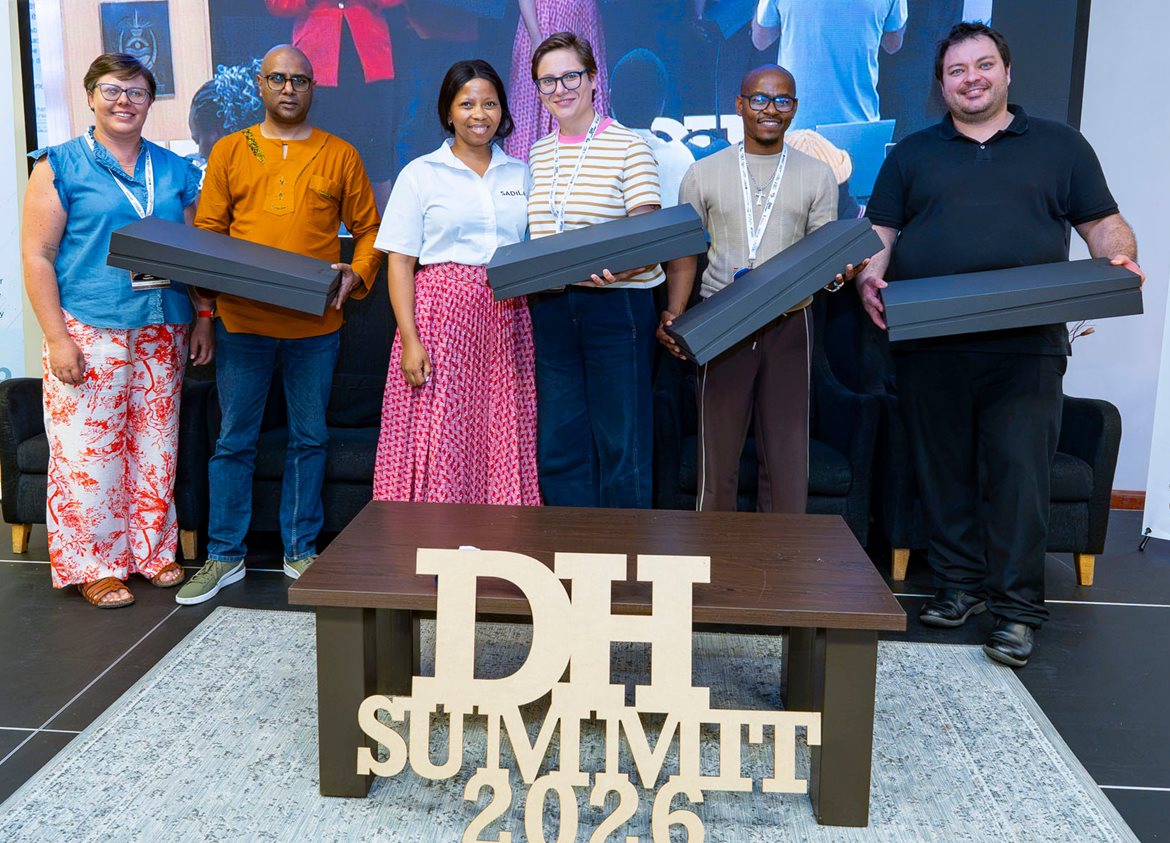
Marissa Griesel (SADiLaR), Dr Denzil Chetty (Unisa), Jessica Mabaso (manager of Esclalator), Prof Janelize Morelli (Manager of North-West University Centre for Digital Humanities), Dr Johannes Sibeko (Coordinator of Digital Humanities Hub at Mandela University) and Juan Steyn (President of DHASA).
Dr Johannes Sibeko, coordinator of Nelson Mandela University’s Digital Humanities Hub, led the University’s team at the summit.
“The summit provided an important opportunity for institutions to consider how Digital Humanities can develop in ways that respond to South Africa’s intellectual, cultural and linguistic contexts,” said Dr Sibeko.
“For Nelson Mandela University, these discussions are particularly relevant as we continue to develop our Digital Humanities curriculum and strengthen interdisciplinary research that draws on digital methods to address questions meaningful to our society.”
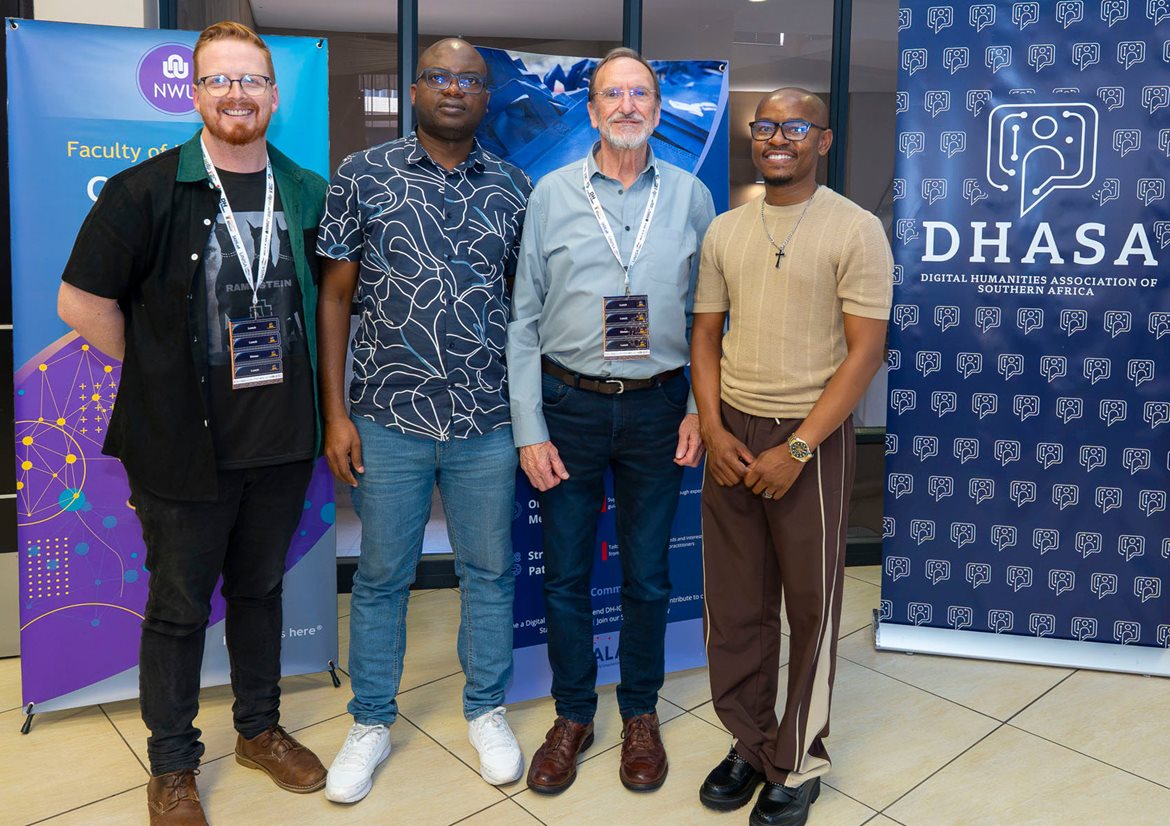
Jonathan van der Walt, (DHH associate), Dr Benjamin Izu (DHH associate), Professor Justus Roux (founding member and the first director of SADiLaR) and Dr Johannes Sibeko
Advancing an African-centred approach
A key theme was the need to develop a shared understanding of Digital Humanities and to use such an understanding to inform approaches grounded in African histories, languages, Indigenous Knowledge Systems and intellectual traditions, rather than simply adopting frameworks developed elsewhere.
Among other things, the discussions explored how Africanisation and decolonisation could shape digital research while positioning African scholars and communities as active contributors to knowledge production.
South Africa’s multilingualism was also recognised as a resource for developing digital tools, expanding research in African languages and contributing to global conversations about technology and knowledge.
These discussions align with Mandela University’s efforts to develop its Digital Humanities curriculum and strengthen interdisciplinary research rooted in local contexts.
Mandela University contributes across key areas
The University contributed to several working groups examining curriculum development, postgraduate training, digital preservation, decolonisation and policy engagement.

Dr Denzil Chetty (Unisa), Dr Johannes Sibeko and Johnathan van der Walt
Jonathan van der Walt presented as part of Working Group 2, which focused on curriculum development and the classification of Digital Humanities within higher education. Dr Benjamin Izu presented with Working Group 5.1, exploring Africanisation and decolonisation in digital knowledge production.
Postgraduate student Anesipho Tshisane contributed online to Working Group 9, which considered policy engagement and institutional recognition, including engagement with the Department of Higher Education and Training, the Council on Higher Education and the Department of Science, Technology and Innovation.
Other university colleagues contributed to pre-summit discussions. Faith Blignaut and Juneth Esau participated in discussions on digital preservation and archives; Solomon Bopape contributed to postgraduate programmes and researcher development; Nompilo Makamu participated in Africanisation and decolonisation discussions; and Qaqambile Sitela contributed to policy engagement.
Professor Pamela Maseko, Executive Dean of the Faculty of Humanities, also joined the summit online, highlighting the importance of sustained collaboration and building on South Africa’s strengths to advance research and benefit communities.
Building capacity through collaboration
The summit’s ten working groups highlighted the need for universities, research infrastructure providers, libraries, archives, heritage institutions, policymakers, funders and communities to collaborate in strengthening research capacity and supporting sustainable digital scholarship.
For Mandela University, the discussions also provided an opportunity to align its developing Digital Humanities curriculum with national priorities.
These include balancing theoretical foundations with practical digital research skills, promoting ethical engagement with technology and ensuring that teaching reflects South African and African contexts.
“Collaboration will be essential if Digital Humanities is to develop into a sustainable and recognised field in South Africa. By connecting our expertise and resources, institutions can strengthen research capacity, support innovative scholarship and ensure that digital approaches respond to the needs and priorities of our communities,” said Dr Sibeko.
Towards a shared national vision
The summit’s discussions will feed into a South African Digital Humanities position paper, with Professor Menno van Zaanen (SADiLaR) and Professor Janelize Morelli (NWU) serving as lead editors. The paper is expected to consolidate the working groups’ contributions and provide a shared reference point for the field’s priorities, future collaboration, policy engagement and institutional development.
For Mandela University, participation reinforces its commitment to contributing to national conversations about digital scholarship while advancing research and teaching that draw on South Africa’s intellectual, cultural and linguistic resources.
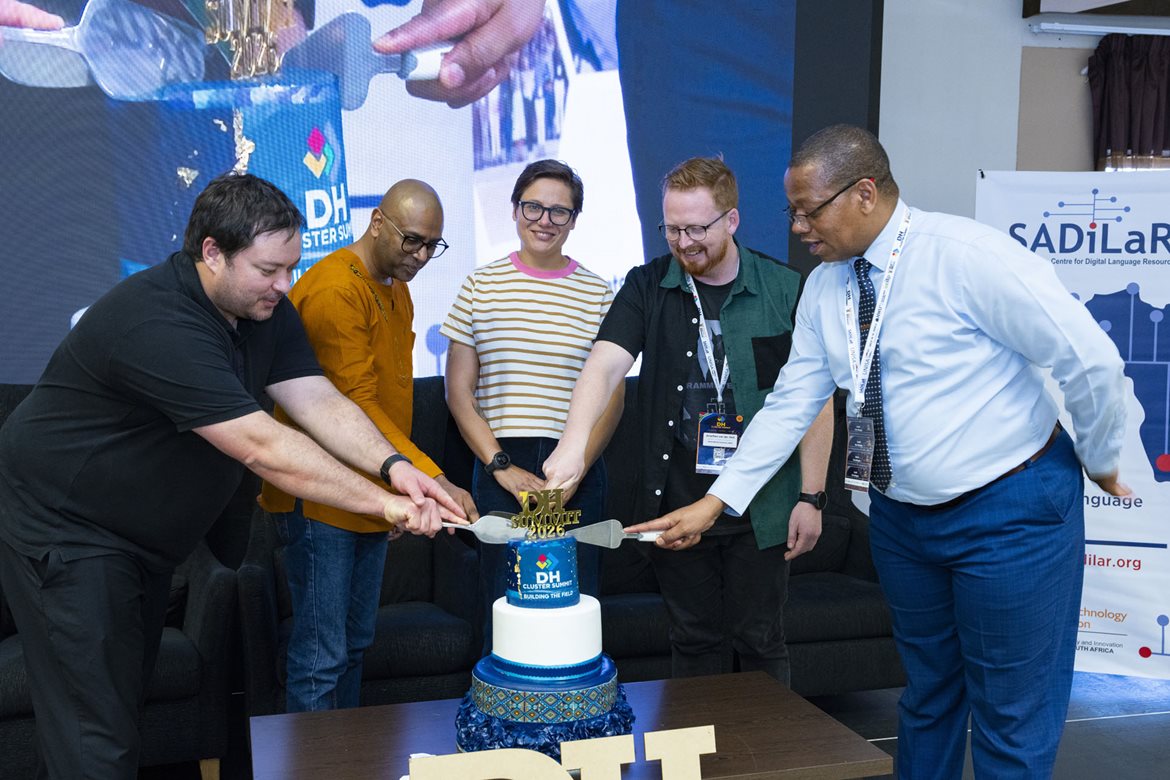
Juan Steyn (DHASA), Dr Denzil Chetty (Unisa), Prof Janelize Morelli (NWU), Jonathan van der Walt (DHH associate) and Prof Langa Khumalo (SADiLaR) cutting the cake to symbolise the inauguration of the Cluster DH summit represent the different partner institutions.