These questions were at the centre of Day 3 of Nelson Mandela University’s annual Research Week, where the Faculty of Humanities explored the theme “Humanising Innovation, Innovating Humanity.”
The theme speaks directly to the University’s 2026 institutional theme, “Forging Intelligent Futures: Research & Innovation shaping AI and AI shaping our research and innovation – in service of people and planet.”
For the Humanities, however, the rise of artificial intelligence is not simply a technological conversation. It is also a conversation about culture, ethics, identity, knowledge and power – and one in which Africa must have a voice.
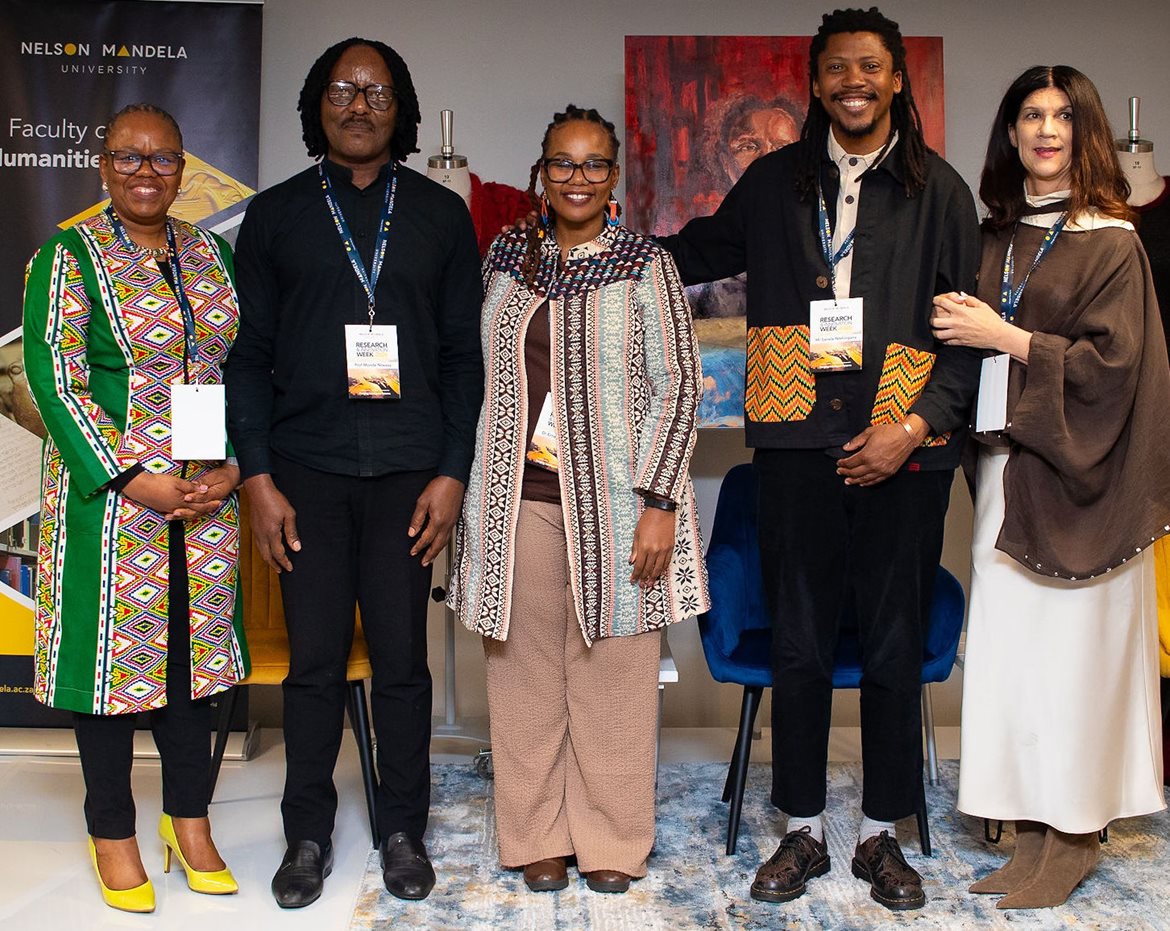
Professor Pamela Maseko, Executive Dean of the Humanities Faculty, Prof Monde Ntwasa, Dr Ernestina Nkooe, Sanele Ntshingana and Dr Jacqui Luck, Deputy Dean
Putting Africa at the centre
Executive Dean of the Faculty of Humanities, Professor Pamela Maseko, said the rapid development of AI presents an opportunity for the Humanities to play a more central role in shaping the future.
“While Artificial Intelligence may be perceived, at first glance, as the preserve of the Sciences and Engineering disciplines, the Faculty of Humanities recognises this moment as an urgent call for disciplines historically concerned with meaning, value, culture, and the human condition to assert their place at the centre of the conversation,” she said.
For Prof Maseko, this calls for the humanisation of innovation, insisting that technological advancement, and artificial intelligence in particular, be interrogated through ethical, cultural, historical, and social lenses so that it serves rather than diminishes human dignity, agency, and diversity.
It also means questioning whose knowledge shapes innovation and whose voices are included in conversations about the future.
“The Humanities must innovate themselves. This starts with recentring Africa in narratives from which it has often been marginalised and recognising African knowledge, people and futures as contributors to global innovation,” she said.
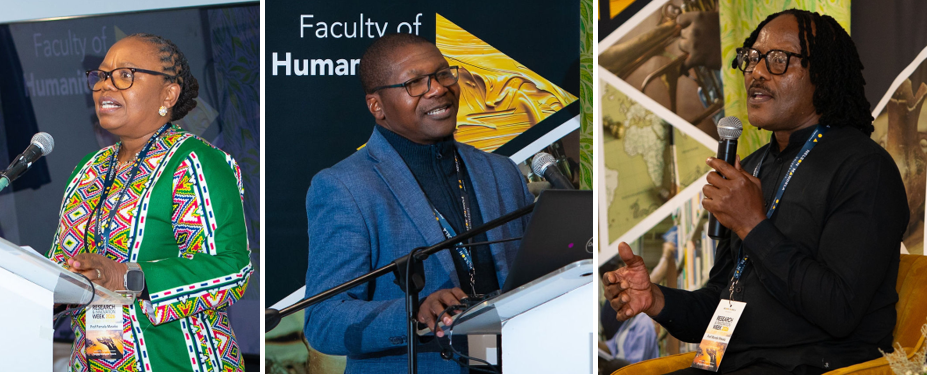
From left, Professors Pamela Maseko, Azwinndini Muronga and Monde Ntwasa
Deputy Vice-Chancellor: Research, Internationalisation and Innovation, Prof Azwinndini Muronga, echoed this call, arguing that Africa should not simply import technologies and priorities developed elsewhere.
“AI is transforming the University now. We therefore need to move from consuming technology to shaping it, while ensuring that research agendas, knowledge production and innovation remain responsive to African priorities and serve the people and planet,” he said.
Africa as a producer, not a consumer
This idea was central to the keynote address by University of South Africa distinguished biochemist and translational scientist Prof Monde Ntwasa.
Prof Ntwasa challenged perceptions of Africa as a continent defined primarily by its challenges, instead highlighting its young population, natural resources and growing markets as potential drivers of future innovation.
He argued that AI’s power is ultimately dependent on data, yet African countries often have limited control over data generated by their own populations.
“The future of labour and innovation lies in Africa and the Global South, we need to start developing our own cloud facilities and owning our data,” he said.
Prof Ntwasa called for Africa to play a greater role in technological development, manufacturing and innovation, arguing that “Africa possesses the keys to the Fourth Industrial Revolution.”
He also challenged conventional ideas about innovation, pointing out that it can involve adapting existing knowledge rather than always creating something entirely new.
“More fundamentally, African academics need to reconsider how knowledge is produced, rather than continually working from Western templates,” he said.
Reclaiming African knowledge
Mandela University’s Dr Ernestina Nkooe of the Department of Geosciences explored this question through research into African coloniality, territorial planning and innovation, using the South Africa-Botswana international border region as a case study.
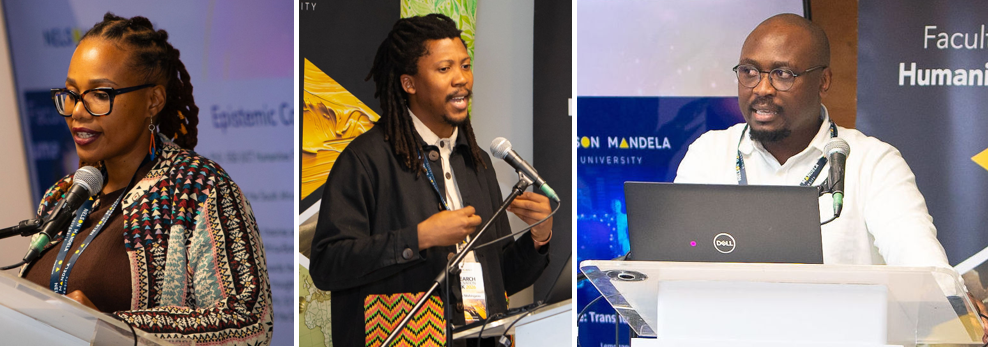
Dr Ernestina Nkooe, Sanele Ntshingana and Lemohang Tebeli
Drawing on Setswana literary texts, archival material and cross-border fieldwork, Dr Nkooe examined how pre-colonial Batswana related to both relational (social) and physical (natural) borders in their autonomous organisation of territorial space. Challenging as a result, the established assumption that territorial innovation through the uses of aspatial and spatial boundaries is primarily a modern or Western idea.
“We need to recentre the African continent as an important space for theorising about our borders and theorising about the politics of our territorial space,” she said.
She also warned that Humanities scholars should approach AI critically when using it to interpret African histories and ways of knowing.
Preserving African voices
Sanele Ntshingana of the University of Cape Town considered another dimension of African knowledge through his work on the digital curation of African intellectual archives, focusing particularly on isiXhosa intellectual and poet S.E.K. Mqhayi.
Rather than simply digitising historical texts, the project brings together written material, photographs, recordings, podcasts, timelines and other multimedia resources.
“The archive brings together written texts, photographs, recordings, podcasts, timelines and other multimedia material, allowing African intellectuals to be encountered through multiple forms of evidence,” he said.
The project also highlights the collaborative nature of Humanities research, bringing together researchers, curators, translators, language experts and archival institutions.
Whose future are we creating?
Lemohang Tebeli of the Department of Philosophy examined transhumanism – the idea that technology can be used to enhance human capabilities – as a political and philosophical question.
He argued that the issue is not simply whether humans can enhance themselves, but who will have access to such technologies and who will control them.
“Enhancement technologies are themselves embedded in political relationships of ownership, in access, in labour, in power,” he cautioned.
Tebeli also called for a stronger African voice in debates about humanity’s technological future, arguing that the continent must “demand its seat”.
Telling our own stories
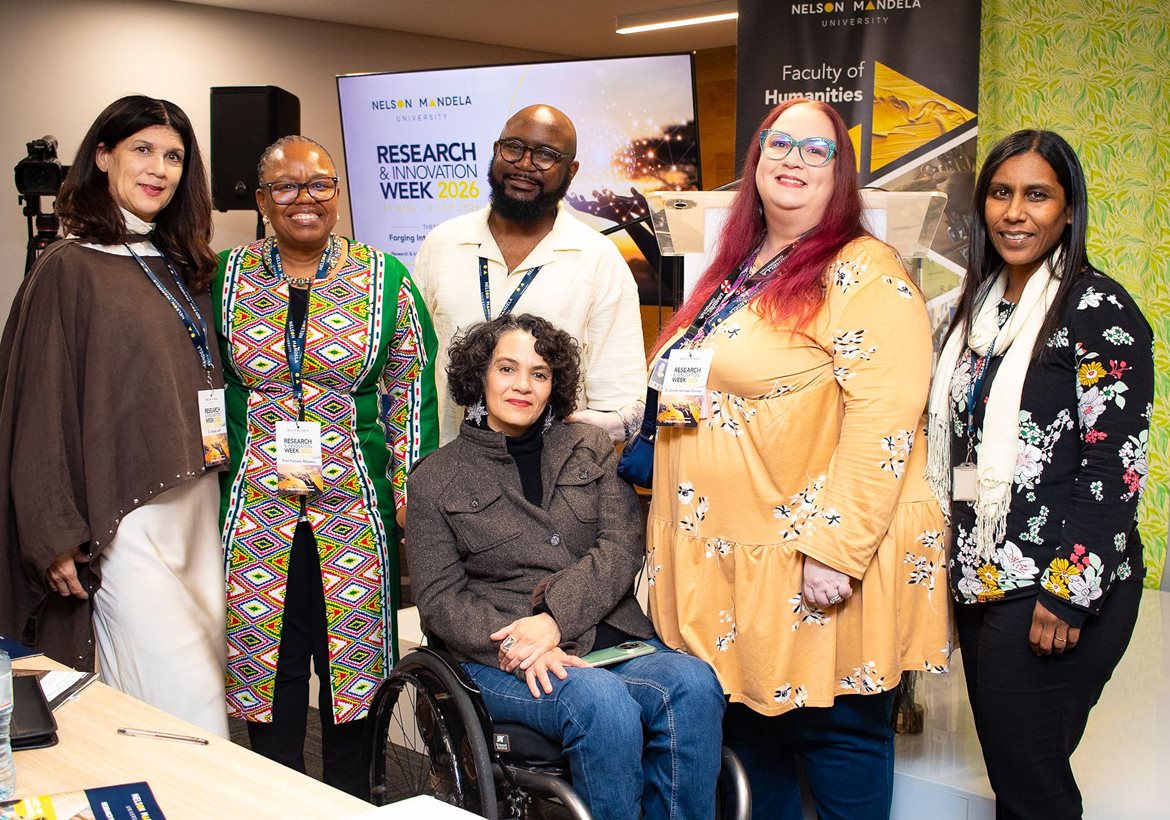
Dr Jacqui Luck, Prof Pamela Maseko, Lungelo Manona, Prof Shelley Barry, Dr Janelle Vermaak-Griessel, all three from Media & Communication Department and Prof Subeshini Moodley, Director of School of Language, Media & Communication.
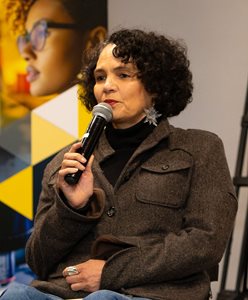 Prof Shelley Barry
The Research Day concluded with a screening of Record, a film executively produced and co-directed by award-winning Prof Shelley Barry of the Department of Media and Communication.
The film, which premiered at the New York African Film Festival in May 2026, follows transgender and gender-diverse people in Southern Africa who were trained in mobile-phone filmmaking and used video diaries to document their lives.
“Rather than having transgender and gender-diverse African lives interpreted by outsiders, the participants/co-directors became active producers of their own narratives,” Prof Barry said.
Record provided a fitting conclusion to the Research Day. Across discussions on AI, data, African knowledge, philosophy, digital archives and filmmaking, the same question emerged: who gets to shape the future, and whose knowledge and experiences are allowed to define it?
For the Humanities Faculty, humanising innovation means ensuring that the answer includes African people, African knowledge and the communities whose lives are being transformed by innovation.