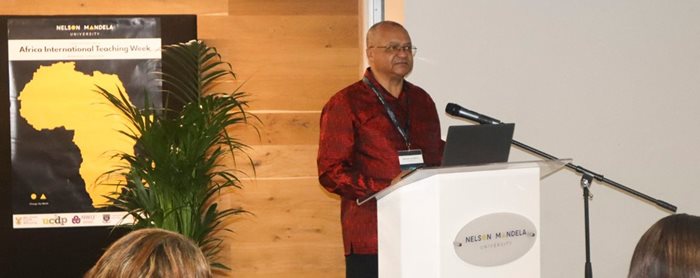
 Professor Lionel Green-Thompson
This message was from Professor Lionel Green-Thompson, Dean of the Faculty of Health Sciences at the University of Cape Town, the keynote speaker at Nelson Mandela University’s Faculty of Health Sciences’ recent Africa International Teaching Week.
The event brought together academics, healthcare professionals and other stakeholders under the theme, “Towards Human-Technology Synergies: Global Innovations for Transforming Health Professions Education and Its Implications for Ethical Leadership and Governance”, exploring technology’s role in health professions education.
In his address, “Technology, Learning, and Relationship,” Prof Green-Thompson challenged educators to consider not only what AI can do, but how it can improve healthcare without undermining human relationships.
“We have to decide what does a professional need to know about the science of AI, and what it’s doing in the background, but more importantly, what it can help them do,” he said.
Reflecting on the growing focus on AI and academic integrity, he cautioned against allowing the discussion to become too narrow.
He stressed that health professions education must keep pace with technological advances while equipping students to critically assess AI’s applications and limitations.
Addressing the growing focus on AI and academic integrity, he cautioned against narrowing the debate to honesty alone.
“I think we are obsessed with the honesty part of AI. If we treated it differently, I think we would get much better,” he said, calling for a broader understanding of how AI can support professional practice.
Ubuntu and its role in fostering respectful relationships between healthcare professionals, patients and communities were central to his address.
Prof Green-Thompson said community engagement had highlighted the need to teach Ubuntu explicitly in health professions education. “Our communities do not have the vocabulary by which they can hold their doctors to account,” he said, emphasising the importance of empowering patients to participate in decisions about their care.
Communities had called for Ubuntu to be taught “explicitly and directly”, with love and respect at its core. “This is not cuddly, soft and sweet love. This is love that allows you to respect me enough that you can fully engage me on my therapy,” he said.
He highlighted concerns about patients leaving healthcare facilities with medication but little understanding of its purpose, stressing the need for clear communication and informed participation in treatment.
These principles, he argued, should also shape health professions education. Universities must consider whether they respect and incorporate people’s voices into teaching and curriculum development.
“When last did the students create the curricula that you are teaching?” he asked, challenging educators to give students a significant role in shaping their education and to recognise the knowledge and experiences they bring.
The event extended these discussions through collaborative workshops exploring AI, interprofessional education, community engagement and inclusive learning.
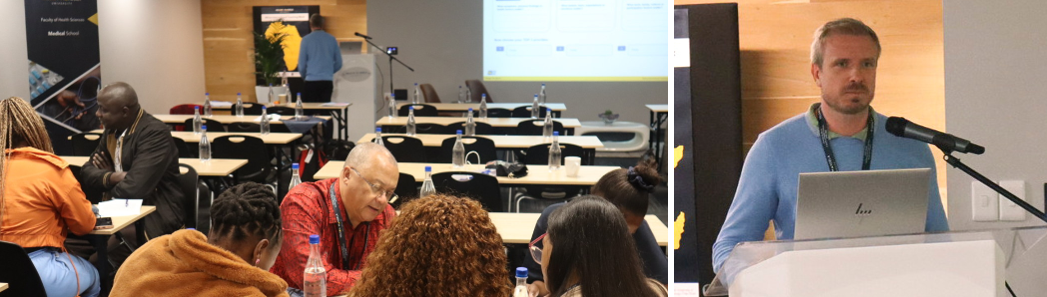
Matthias Kalmring's workshop
Matthias Kalmring, a junior researcher at the University of Applied Sciences St. Pölten in Austria, facilitated “Intelligence without Intuition: Using AI to Teach, Not Replace, Clinical Reasoning.” The workshop examined how AI can support clinical reasoning, while keeping human judgement central to healthcare education.
Dr Aayesha Kholvadia, Head of the Department of Human Movement Science at Mandela University, led “Are We Ready to Learn Together? Co-designing Sustainable IPECP Pathways,” exploring collaborative approaches to interprofessional education and practice.
Dr Abongile Pindo’s workshop, “Fostering Community-Engaged and Socially Accountable Future Healthcare Professionals Through the Use of mHealth Technologies for Rural Healthcare Access,” explored how mobile health technologies can improve rural healthcare access while strengthening community engagement and social accountability.
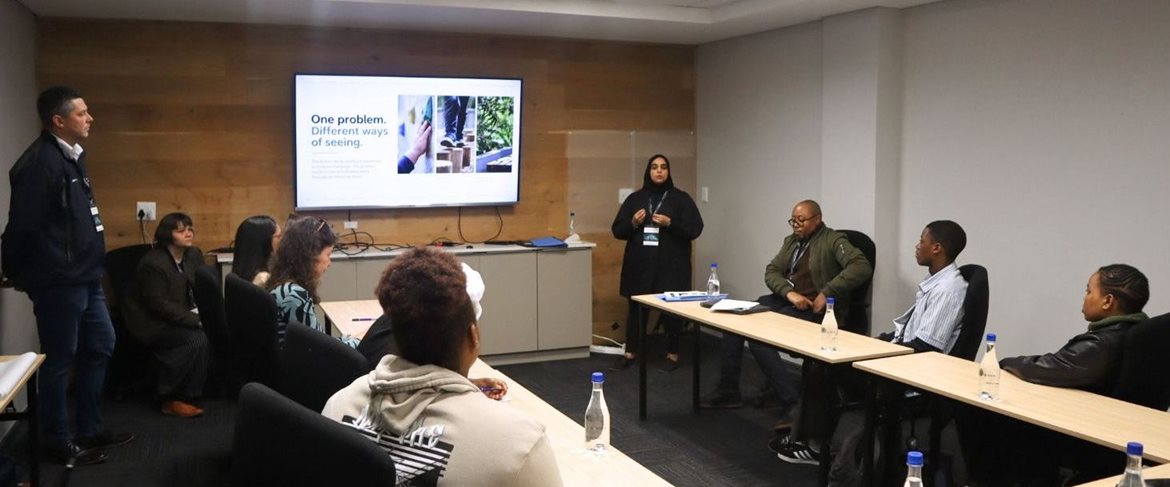
The joint workshop by Dr Jean-Pierre Basson, Dr Aayesha Kholvadia and Kim Harmse
A further session, “Space, Movement and Inclusion: Learning Across Disciplines Through the Merryvale Courtyard Case,” presented by Dr Jean-Pierre Basson, Head of the Department of Architecture and Doctoral Programme Coordinator, Dr Kholvadia and Kim Harmse discussed interdisciplinary learning through space, movement and inclusion.