Nelson Mandela University Department of Forestry in the Faculty of Science recently hosted its seventh webinar, bringing together forestry experts and researchers to explore how technology and innovation are shaping the future of plantation management.
The webinar, themed “Pathways to Precision Silviculture”, was sponsored by the International Union of Forest Research Organisations (IUFRO), reinforcing the importance of global collaboration and knowledge-sharing in advancing forestry research and practice.
Professor Christa Grobler, Dean of the Faculty of Science, welcomed participants, while senior lecturer in Forestry, Dr Muedanyi Ramantswana provided an overview of the theme, setting the context for discussions on the evolving role of precision technologies in forestry.
Prof Vladan Ivetic from the University of Belgrade, Serbia, introduced IUFRO, highlighting the organisation's global contribution to collaboration, research and knowledge exchange within the forestry sector.
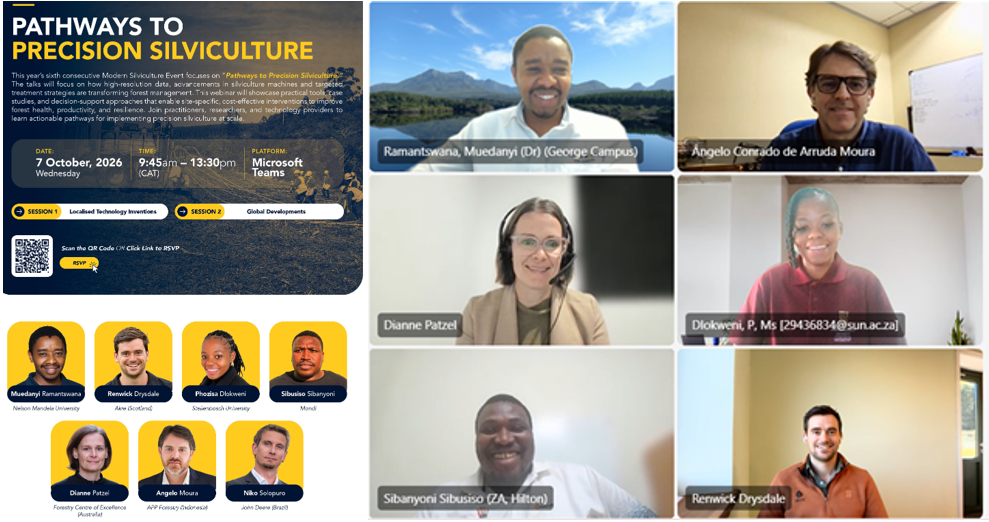
Six presenters shared insights into emerging technologies, research developments and practical approaches aimed at modernising forestry operations.
Renwick Drysdale from Akre Scotland presented an integrated approach to woodland creation, incorporating nursery production, project management, carbon and biodiversity credits and monitoring. He highlighted the importance of low-carbon nursery design and innovative seedling technologies in improving resource efficiency and establishment success.
Focusing on vegetation management in eucalypt plantations, Phozisa Dlokweni from Stellenbosch University, compared knapsack, tractor-mounted and drone-based spraying methods. Her presentation examined the productivity, cost, terrain suitability and vegetation-control capabilities of each approach, demonstrating how technology choices need to respond to operational conditions.
Sibusiso Sibanyoni outlined Mondi's transition from manual planting towards semi-mechanised and single-pass planting systems. Drawing on trial results, he shared developments in planting operations and plans to incorporate GPS data to improve operational precision and efficiency.
Bringing an international perspective, Dianne Patzel from Australia's Forestry Centre of Excellence, shared silviculture research and innovations from Australia's Green Triangle region. Her presentation explored mechanical planting, remote sensing, artificial intelligence-supported pest and disease monitoring, wildlife detection and water-use management.
Dr Angelo Moura of APP Forestry, Indonesia, provided an overview of current and emerging forestry technologies, emphasising the importance of evaluating innovations under real operating conditions. He noted that technology adoption should be informed by practical application and demonstrated economic value rather than novelty alone.
Niko Solopuro from John Deere, Brazil, focused on precision and mechanised plantation operations, highlighting digitally guided soil preparation, developments in automated planting and the critical role of seedling quality in successful plantation establishment.
Across the presentations, a common message emerged: precision silviculture is not simply about introducing more technology into forestry operations, but about applying the right technologies to the right conditions and measuring their value.
Speakers emphasised the need to assess innovations against practical considerations, including planting quality, seedling survival, operational safety, productivity and cost.
The webinar provided a valuable platform for sharing local and international experiences, demonstrating how research, technological innovation and collaboration can contribute to more productive and sustainable forestry practices.
Through initiatives such as this webinar series, the University's Department of Forestry continues to create opportunities for knowledge exchange and engagement on developments shaping the forestry sector, supporting the University's commitment to research excellence and socially just and sustainable futures.