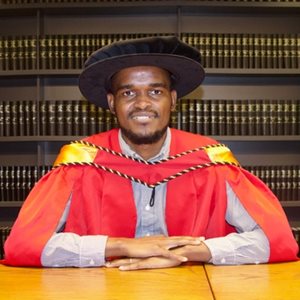
 Dr Mahlubandile Ntontela
Dr Ntontela, who recently graduated with a Doctor of Laws degree from the University of Fort Hare (UFH), argues that witnesses should not be prevented from giving evidence simply because they cannot communicate through conventional speech.
His research highlights how the criminal justice system’s reliance on oral testimony can create barriers for people who use Augmentative and Alternative Communication (AAC) systems to express themselves.
AAC systems provide alternative ways for people with communication disabilities to convey information and may include specialised devices and other communication tools.
However, courtroom procedures that prioritise spoken testimony can make it difficult for these witnesses to participate fully in criminal proceedings.
To address this challenge, Dr Ntontela proposes that courts interpret existing rules of evidence in ways that allow witnesses to testify using AAC systems.
He also recommends developing specific courtroom guidelines to help judicial officers receive and assess evidence presented through these communication methods.
“These guidelines will, in turn, ensure that the evidence led through the AAC system meets the evidentiary requirements of credibility and reliability, among others,” he states.
The study raises important questions about whether South Africa’s criminal procedure rules are sufficiently flexible to accommodate witnesses who cannot communicate through conventional speech, without necessarily relying on sign language interpretation.
Dr Ntontela situates his findings within the constitutional right of access to justice and Article 13 of the United Nations Convention on the Rights of Persons with Disabilities, which calls for appropriate procedural accommodations to ensure people with disabilities can effectively participate in legal proceedings.
“The study, therefore, goes beyond identifying a procedural difficulty. It points to a need for the legal system to recognise different communication pathways (outside of sign language services) when determining how evidence can be presented in court,” he says.
Beyond changes in courtroom practice, Dr Ntontela advocates for further constitutional and legislative reforms to strengthen the rights of people with communication disabilities when accessing criminal courts.
He also calls for greater recognition and acceptance of available communication systems as legitimate means of presenting evidence.
The implications of the research are significant, particularly in cases where a witness’s testimony may be central to establishing the facts, but conventional speech is not an accessible means of communication.
Dr Ntontela’s findings make the case for a more inclusive criminal justice system in which courtroom procedures adapt to witnesses’ communication needs, rather than allowing disability to become a barrier to participation and justice.
His doctoral research was supervised by Dr Ntandokayise Ndlovu, Senior Lecturer in Public and Constitutional Law at the University of Fort Hare.
Dr Ntontela was inspired by the injustice he observed while practising as an attorney in the criminal courts. Many criminal cases involving witnesses with communication disabilities never reached trial due to systemic barriers and the witnesses' inability to understand the South African Sign Language used by the court interpreters.
“Even in matters that go to trial, there are challenges regarding the credibility and reliability of evidence led by witnesses with communication disabilities. This prompted me to pursue a study examining the use of Augmentative and Alternative Communication systems in courtrooms,” Dr Ntontela says.
“It's not one case but many matters I have observed over the years where matters are either not enrolled, withdrawn, or struck off the roll due to shortcomings in criminal matters involving witnesses with communication disabilities,” he said.
The differential treatment is not only an injustice towards people with communication disabilities but also violates the Constitution of the Republic of South Africa and the United Nations Convention on the Rights of People with Disabilities, Dr Ntontela says.