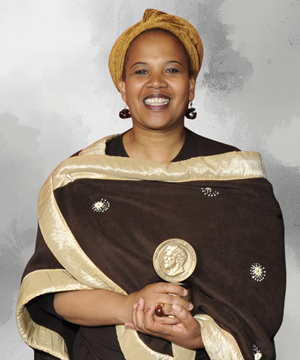
Since starting her company, Nayanaya Pictures, in 1997, she has directed and produced features, documentaries and series that are unafraid to challenge systems of power across politics, pharmaceuticals, health crises and more – considering those most affected at the centre of her lens, particularly women and children.
The acclaimed and celebrated auteur is currently visiting the Centre for Women and Gender Studies, who are hosting a series of engagements that allow the University community, high school learners and city to engage with her fascinating and vital practice.
On 29 September, the CWGS is hosting a screening of her film “Standing on their Shoulders” at 13:00 at the Science Centre on Ocean Sciences Campus, alongside a masterclass for film students on 2 October.
Sithole is a two-time Peabody and BAFTA Award winner, who began her career as an actress, with roles in notable films that include Cry Freedom (1987), Mandela (1987), A Dry White Season (1989), Fools (1997), and Chikin Biznis (1999).
Through Nayanaya Pictures, she has spearheaded an extraordinary filmography that includes Shouting Silent (2002), Orphans of Nkandla (2004), Martine and Thandeka (2008), Zimbabwe's Forgotten Children (2010) and their Shoulders (2018), among other titles.
These works have focused on the HIV/AIDs crisis, xenophobia, political unrest and the history of the women’s movement in South Africa, taking on weighted thematics that are explored through a tender, human focus.
Nayanaya Pictures tells critical stories. For almost 30 years, the production house has reflected an uncompromising feminist consciousness, considering questions of social justice that remain unsettled in the present. Her filmography demonstrates how creative work is intellectual, providing a powerful political education that speaks through every frame.
Sithole’s films have been presented at major international festivals, cultural forums and prestigious educational institutions.
These include Encounters, the African Film Festival, Human Rights Festival, Cannes Film Festival and Yale University. Notably, she is the first South African to win a prestigious British Academy of Film and Television Arts (BAFTA) award, received both Peabody and Prix Italia Awards and was also nominated for an international Emmy award.
Her upcoming documentaries include “We Will Not Die Quietly”, which explores access to affordable medication and Big Pharma through a focus on Brazil and India, “Mandela: Man of Peace” examining his peace initiatives and legacy, “Marching On” which explores Black Women’s transnational activism, and a three-part series on climate justice.
As part of her visit, Sithole presented a guest lecture to the Introduction to Film Studies class – inspiring students and saying that “It’s very important for young people to know that you can be anything you want to be” and urging them to put in the time and learn all areas of film production.
To RSVP for the film screening, please email danielle.bowler@mandela.ac.za.
About Standing on their Shoulders (2018):
Xoliswa Sithole, takes us on a historical journey through time in this documentary that connects female resistance movements in South Africa.
The starting point of the documentary is 9 August 1956, which marks the day that 20,000 women marched to the Union Buildings in Pretoria in protest again the dehumanising apartheid law that required all Africans to carry a pass. “You have touched a woman, you have struck a rock,” they chanted, a mantra which has continued to stand as testimony to the resilience of many remarkable South African female activists, including Lilian Ngoyi, Helen Joseph and Albertina Sisulu.
From the female resistance movements of the 1950s, the documentary takes us up to the end of apartheid, reminding us of the unwavering strength and courage of Winnie Madikizela Mandela and other women from the ANC, and into the contemporary era with the continued struggles against patriarchy fought through the ‘fallist’ movements. While women’s voices in political movements are often silenced and marginalised, the film gives a powerful platform to feminist activists, scholars, students and political leaders, to highlight the work that women continue to do in fighting patriarchy, race and class oppression.