This was the focus of Entangled – How might we reshape our entanglement with the environment? a public lecture led by Brian Castellani, visiting Professor in the Chair in Identities and Social Cohestion (ISCIA) within the Faculty of Humanities.
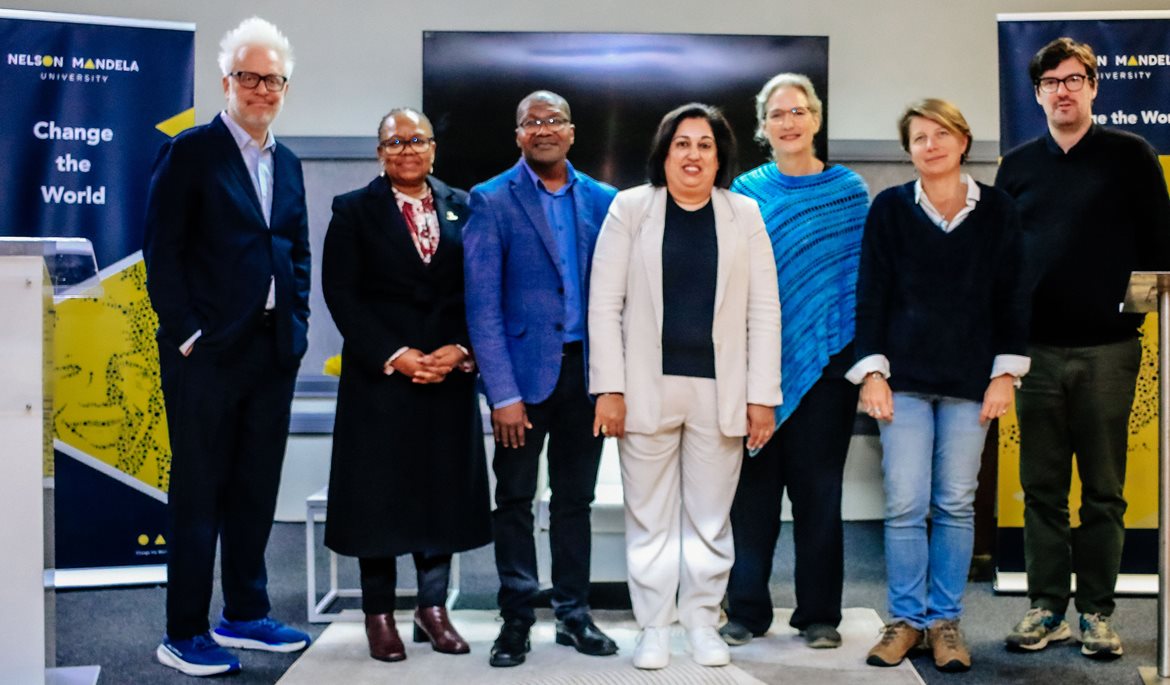
From left, Professors Brian Castellani, Pamela Maseko and Azwinndini Muronga, Harsheila Riga, Professors Andrea Hurst and Lorien Pichegru and Dr Jonathan Wistow
For Prof Castellani, “entanglement” offers a way of understanding why environmental challenges can persist even when their causes and consequences are well known.
“In South Africa, ecological systems are interwoven. Pollution, just transition and ecological improvement are inseparable from jobs, inequality, infrastructure and economic development,” he told the audience on the University’s Bird Street Campus.
Understanding entanglement
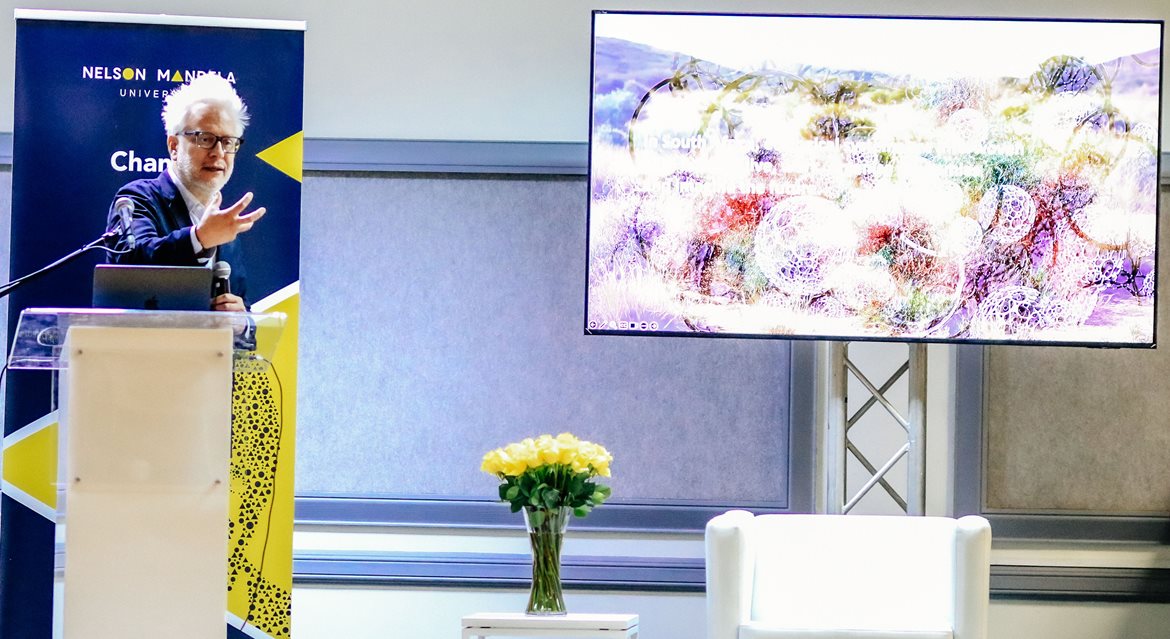
Drawing on complexity sciences, the humanities and visual arts, Prof Castellani described entanglement as a process in which repeated interactions create deeper dependencies over time.
He illustrated this through examples ranging from fungal networks and marine debris to smartphones and energy systems. Fishing nets and plastic waste, for example, can become entangled through repeated contact with currents and coastal structures, with additional material becoming caught in the process.
Similarly, technologies such as smartphones can become deeply embedded in everyday life as they move beyond communication into banking, navigation, work and entertainment.
“The same principle applies to energy systems. Coal, has properties that have enabled societies to build infrastructure and economies around it, providing employment and economic stability while also contributing to environmental harm,” Prof Castellani explained.
“This complexity means that environmental challenges cannot always be approached through an “either/or” lens. An arrangement can provide economic or social benefits while simultaneously causing environmental damage. Changing one part of the system can therefore have consequences elsewhere.”
The role of the humanities and imagination
A key theme of the lecture was the role of the humanities and arts in helping society imagine alternatives.
This idea was brought to life through Entangled, a short science-fiction film created by Prof Castellani in 2025 as part of ISCIA’s Horizon 2055 project. The film imagines an unfamiliar form of life arriving on Earth with the ability to repair damaged environments, only to encounter the social, economic and cultural systems in which that damage is embedded.
For Prof Castellani, the arts can make familiar circumstances strange enough to see them differently, opening space to consider not only what is possible, but what kind of future society wants to create.
From disentanglement to re-entanglement
Rather than seeking a simple escape from existing entanglements, Prof Castellani proposed thinking in terms of loosening, reimagining, redirecting and reweaving relationships.
He also cautioned that environmental change does not mean returning to the past. Instead, societies need to think about the future they want and work backwards from that vision, while recognising that new arrangements will bring their own challenges.
The lecture was particularly relevant to Gqeberha and the wider Nelson Mandela Bay region, where environmental concerns intersect with the ocean, water, industry, livelihoods and communities.
A conversation across disciplines
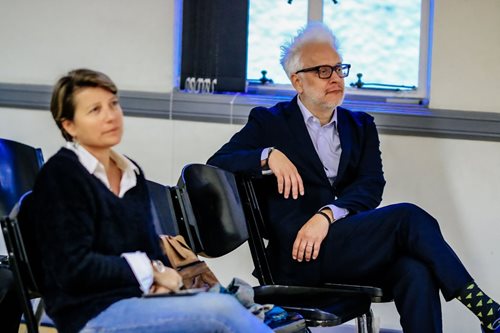 Professors Lorien Pichegru and Brian Castellani
Responding to the lecture was Prof Lorien Pichegru, a marine biologist from Mandela University’s Coastal and Marine Research Institute, whose work includes conservation and advocacy relating to the marine environment and African penguins.
Her response brought a biological and conservation perspective to Prof Castellani’s argument, including the challenge of addressing environmental problems where different stakeholders have different understandings of their relationship with nature.
Welcoming guests on behalf of the Faculty of Humanities, Executive Dean Prof Pamela Maseko highlighted the importance of interdisciplinary conversations around environmental questions, noting that these are also questions of values, history, culture, power, identity and responsibility.
For ISCIA Chair Holder Prof Andrea Hurst, the public lecture provided an opportunity to bring complexity sciences, the humanities and visual arts into conversation while connecting the University’s research community with wider questions of environmental sustainability.
Prof Azwindini Muronga, Deputy Vice-Chancellor: Research, Innovation and Internationalisation at Mandela Uni, echoed the importance of environmental sustainability and stewardship as core values of the University.
The lecture formed part of ISCIA’s broader Social Complexity Retreat, which provided researchers, postgraduate students and other participants with space to explore how complexity thinking could inform their scholarly, creative and professional work.
The evening demonstrated the value of bringing different disciplines into conversation around complex challenges – not simply to ask what needs to change, but how the relationships that sustain existing systems might be reshaped.